
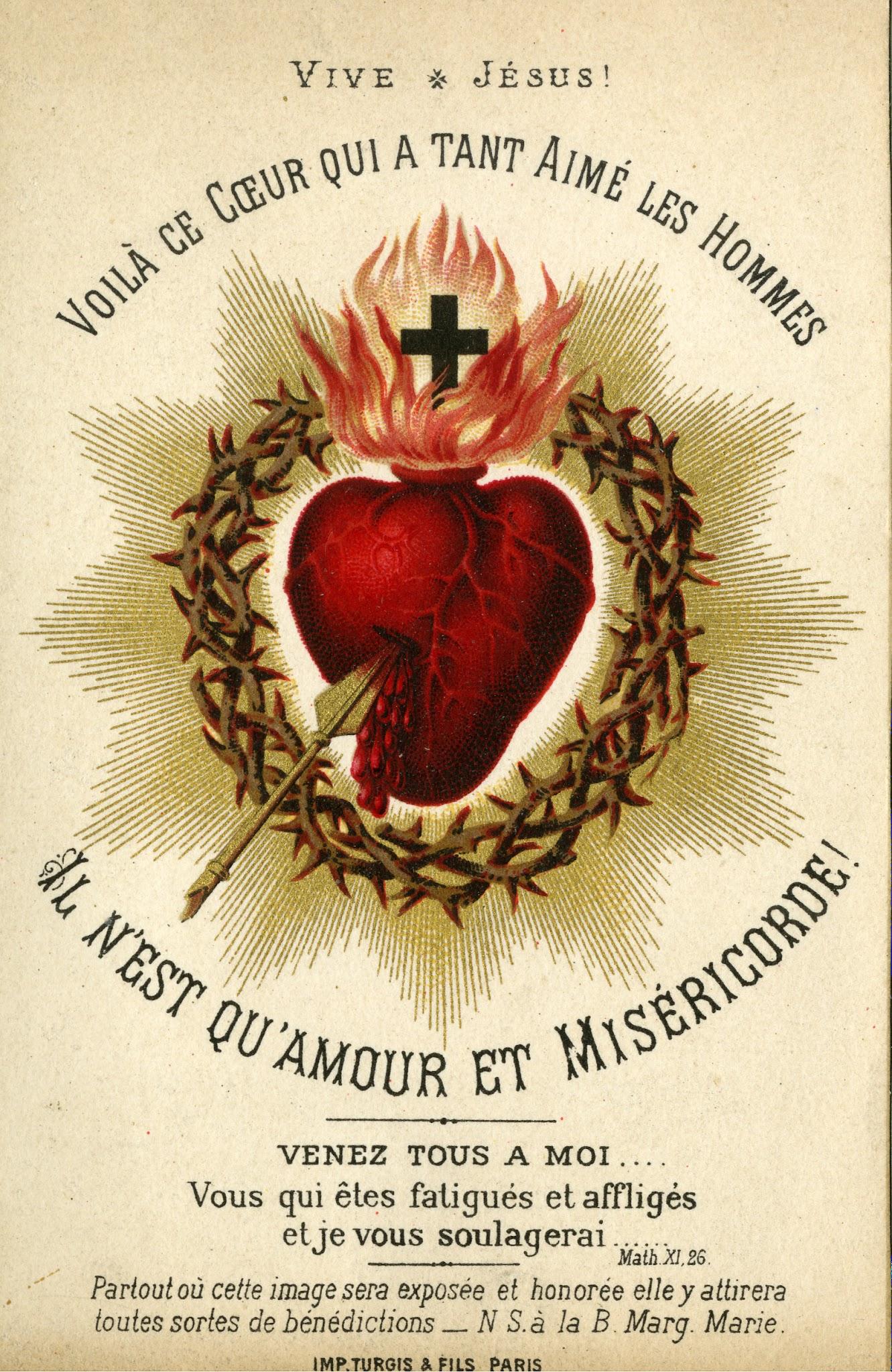
Come to the Marriage Feast!
Blessed are those who are invited to the marriage supper of the Lamb. (Rev 19,9)
The kingdom of heaven may be compared to a king who gave a marriage feast for his son. And he sent his servants to call those who were invited to the marriage feast; but they would not come. Again he sent other servants, saying, ‘Tell those who are invited, Behold, I have made ready my dinner, my oxen and my fat calves are killed, and everything is ready; come to the marriage feast.’ But they made light of it and went off, one to his farm, another to his business, while the rest seized his servants, treated them shamefully, and killed them. The king was angry, and he sent his troops and destroyed those murderers and burned their city. Then he said to his servants, ‘The wedding is ready, but those invited were not worthy. Go therefore to the thoroughfares, and invite to the marriage feast as many as you find.’ And those servants went out into the streets and gathered all whom they found, both bad and good; so the wedding hall was filled with guests. But when the king came in to look at the guests, he saw there a man who had no wedding garment; and he said to him, ‘Friend, how did you get in here without a wedding garment?’ And he was speechless. Then the king said to the attendants, ‘Bind him hand and foot, and cast him into the outer darkness; there men will weep and gnash their teeth.’ For many are called, but few are chosen. Mt 22,1-14
This brochure of the Marian Movement of Priests and Laity presents the Holy Church as the Bride of Christ: the parable of Jesus about the royal wedding feast, the mystery of the triple holy Church, the nuptial life of many saints, and the Holy Mass as the sun and wedding feast of our life – with testimonies of grace and of the persecution of the Church in our time.
Contents
- Foreword
- The Mystery of the Triple Holy Church
- Nuptial Longing
- The Holy Mass – the Sun of Our Life
- Come to the Marriage Feast!
- The Mother’s Tears
- A Silent Guide to the Catholic Faith
- The Fish in the Net of the Church
- The Persecuted Church
- The Conversion of an Actor
- The Divine Star and the Nuptial Soul
- Prayer for Vocations
Foreword
God devised for mankind only one single way to eternal blessedness, and this way is Jesus Christ, the Son of God made man, Himself. He said: No one comes to the Father but by Me. I am the way. (Jn 14,6) Jesus prepared this way for us through the loving self-giving of His life on the cross, as the expression of the highest love and of the glorification of the Father (cf. Jn 17,1-5), and as an atoning sacrifice of most sweet fragrance for the redemption of mankind (cf. Eph 5,2). As the only and eternal High Priest of mankind, Christ has truly and substantially left the sacrifice of His loving self-surrender on the altar of the cross to His Church in the mystery of the Eucharist. In doing so, Christ has inseparably joined the making present of His sacrifice on the cross with His wedding feast. He celebrates this wedding feast by giving His Flesh and Blood to His bride, the Church, and to every believing and loving soul. The greatest act of love in the whole history of creation and of mankind is the priestly self-offering of Jesus Christ on the cross. Here on earth it is celebrated in the Sacrament of the Eucharist until His return.
Blessed are those who are invited to the marriage supper of the Lamb. (Rev 19,9) These words reveal the deepest meaning of the goal for which God created man. He created us to let us share in His own divine life, and this life is the supernatural, eternal life. Sharing in divine life means the highest happiness and joy; the image of the wedding feast stands for this. It is the beatific vision of the ineffable and incomprehensible being of God Himself. Eternal life is a life of the most intimate unity of the creature with its Creator. God is love (1 Jn 4,8), and therefore one can be one with Him only by loving Him. The eternal happiness in heaven is the highest possible fulfillment of the first and most important commandment, namely, to love God with the whole heart, with the whole soul, with the whole mind and with all one’s strength. (cf. Deut 6,4-5; Mk 12,30)
This act of love is so tremendous that it will endure for all eternity as a remembrance and as heavenly liturgy, as the Book of Revelation proclaims to us in the image of the marriage supper of the Lamb. Therefore Christ also remains High Priest for all eternity. (cf. Heb 7,24)
Jesus Christ, the Eternal High Priest, is the only way to eternal blessedness. However, He has inseparably joined this way with the truth, for He Himself is the truth. (cf. Jn 14,6) He came into the world to bear witness (‘martyrein’ in Greek) to the truth (cf. Jn 18,37), and He is the witness (‘martys’ in Greek), the faithful (‘fidelis’) and the true (‘verus’) in person. (cf. Rev 3,14) From this we recognize that the way to eternal blessedness, to the marriage supper of the Lamb, means a way of unconditional faith and of holding fast to the truth, even to martyrdom. Without faith, that is, without the faithful holding fast to the truths revealed by God, it is impossible to please God (cf. Heb 11,6), that is, impossible to enter heaven.
Nothing is more alien to the mind of Jesus Christ and of the Gospel than to understand or to live Christianity and the way to heaven as a sentimental stroll shaped by individual preference, or as a lavish à la carte menu. Such a Christianity would be without the cross, without sacrifice, without obedience to the clear will of God, without self-denial. It would therefore be a Christianity without true supernatural love, and therefore without true joy, without a true marriage supper of the Lamb, because the Lamb is by its very nature an innocent being offered in sacrifice. Such a Christianity would be an illusion. It would be a Christianity of the “ego”, and therefore the greatest antithesis to Christ Himself and of true Christianity, that is, its most hideous caricature.
Since her beginnings the Church has been aware of the danger that such an illusory and caricatured Christianity without cross and without truth, and consequently also without love, entails. Therefore the first Christians, and since then all generations of true Catholic believers, have always taken to heart these words of the Apostle Jude (Thaddeus): Contend for the faith which was once for all delivered to the saints. Remember what the apostles of our Lord Jesus Christ foretold. They told you that in the last time there would be scoffers, following their own ungodly passions. It is these who set up divisions, worldly people, devoid of the Spirit. But you, beloved, build yourselves up on your most holy faith; pray in the Holy Spirit; keep yourselves in the love of God; wait for the mercy of our Lord Jesus Christ unto eternal life. Have mercy on those who doubt; snatch them out of the fire and save them. (Jude 3,17-23)
The greatest and most effective help on the long, arduous and perilous way to eternal blessedness is Jesus Christ Himself, namely with the gift of the Holy Sacrifice of the Mass, the true presence of His sacrifice on the cross and the nourishment of His Body and Blood. This is the greatest treasure, the true spiritual sun of the Church. Yes, already here in this vale of tears it is an anticipation of the marriage supper of the Lamb in eternal life.
The Holy Sacrifice of the Mass and Holy Communion are also the most effective means for the soul to grow in true eternal love for God, in nuptial love for Him. And this in turn means nothing other than holiness of life.
God willed that the sacrifice of the cross, together with the transubstantiation of bread and wine into the Body and Blood of Christ, can be accomplished sacramentally only by priests. Without priests there is no Holy Sacrifice of the Mass and no Holy Communion, and consequently the true spiritual sun then goes out in the life of the Church. However, we need not only priests, but above all holy priests. Christ, the chaste, truthful and merciful Eternal High Priest, wants also in our so dark and confused time to walk again through our streets in His priests, teaching those who err and doubt the truth, comforting those who suffer, granting the forgiveness of sins to penitent sinners, and above all offering the Holy Sacrifice of the Mass. Therefore the priests, His human instruments, should also be chaste, ready for sacrifice and humble, and always bear witness to the truth, even to martyrdom.
The remembrance of the truth about the calling of all Christians to holiness, and first of all of priests, about the central significance of the Holy Eucharist in the life of the Church, through an ever deeper believing penetration of the truth and of a Holy Sacrifice of the Mass celebrated sacredly and in a manner befitting the divine majesty, and through the fruitful and reverent reception of Holy Communion with a pure, believing and humble heart: this is where the real meaning and the goal of the Second Vatican Council should indeed have lain, according to the intention of most of the council fathers.
Only the true renewal from the mystery of the Eucharist, in keeping with the constant sense of the Church and of all saints, will bring forth saints in the Church of our days: holy children, holy young people, holy families, holy consecrated brides of Christ, holy religious and above all holy priests. Only then will a true spiritual spring be granted to the Church. We firmly hope for this spring, and it is already present even in our days, beginning first in the souls who love Christ intimately with a bridal love and who have made the Eucharistic Christ the center of their lives.
The present little book “Come to the Marriage Feast!” will undoubtedly be a concrete spiritual help toward the so longed-for true Eucharistic renewal of the Church, and will give many souls light, comfort and encouragement toward love of God and neighbor and toward holiness.
May God bless the spread of this small, valuable booklet with many spiritual fruits!
May we, united with our dear Mother Mary, the first tabernacle of the incarnate Savior, often repeat the following words of an old, well-known Communion hymn, which may increase in us faith and supernatural love for our Eucharistic Lord:
Jesus, Jesus, come to me, oh, how I long for You!
My soul’s dearest friend, when shall I be united with You!
A thousand times I desire You; to live without You is pain.
A thousand times I sigh to You: O Lord Jesus, come to me!
No delight in the world can satisfy my heart.
Your love, Lord, alone can gladden my whole heart!
True, I am not pure, O Lord, that You should come in to me;
but one word from Your mouth, and my soul will be healed.
Earnestly I long for You: Jesus, Jesus, come to me!
Take my whole heart for Yourself and possess it forever. Amen.
May God’s rich blessing be upon the authors, distributors and readers of this little book!
June 29, 2019, on the Solemnity of Saints Peter and Paul, Apostles
+ Athanasius Schneider, Auxiliary Bishop of the Archdiocese of Mary Most Holy in Astana (Nur-Sultan)
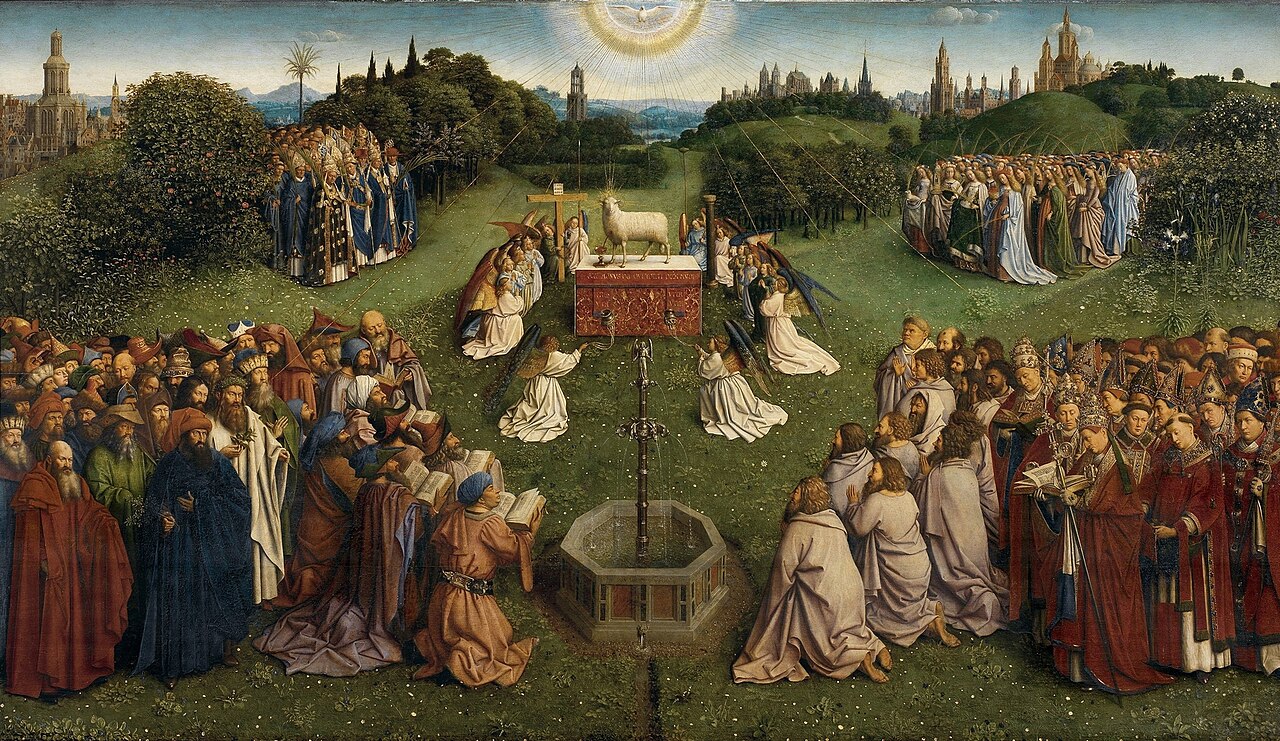
The Adoration of the Mystic Lamb (Ghent Altarpiece, Jan van Eyck)
The Mystery of the Triple Holy Church
The triple holy Church consists of the Church militant, the Church suffering and the Church triumphant. The Christians on earth are the Church militant, the souls in purgatory the Church suffering, and the blessed in heaven the Church triumphant. All three together form, through their intimate union with Christ, the Kingdom of God. In the Creed we call this communion “the communion of saints,” because all are to be united with Christ, their Bridegroom, through sanctifying grace.1
The communion of saints on earth lets us share in all the treasures of grace of the Church. The union with the saints in heaven brings us a share in their merits and help through their intercession before God. The communion with purgatory is a great help for us and for the Poor Souls, who suffer so painfully. Through Holy Masses, indulgences, prayers and good works that we offer for them, we can shorten their pains, and they in turn show us their great gratitude by storming heaven on behalf of all our concerns.2
1 That Christ is the Bridegroom of the Church was hinted at by the prophets, and John the Baptist proclaimed it. The Lord Himself called Himself “the bridegroom.” (Mk 2,19) At the same time, as the Apostle Paul emphasizes, He is also “the head of the body, the church” and “loved the church and gave Himself up for her.” (Col 1,18; Eph 5,25) Likewise, the Apostle presents the Church and every believer who is a member of the Body of Christ as a bride whom he has “betrothed” to Christ the Lord, so that she may be one spirit with Him. (cf. 1 Cor 6,15-17; 2 Cor 11,2) (cf. CCC 796)
2 The Poor Souls are among the deepest connoisseurs of earthly need and of human existence. Since they live in an experience of God that we cannot yet access, they are filled with a power of love for us and are especially the most faithful friends of those who shorten their way to the vision of God through prayer and sacrifice. (St. John Fisher)
Let us rejoice and exult and give Him the glory.
For the marriage of the Lamb has come, and His Bride has made herself ready.
It was granted her to be clothed with fine linen, bright and pure.
For the fine linen is the righteous deeds of the saints.
Someone said to me: “Write this: Blessed are those who are invited to the marriage supper of the Lamb.”3 Rev 19,7-9
3 We cannot obtain our salvation except in the mystical body of the Church, whose head is Christ and whose members we are. […] There is no other way and no other gate for us. (St. Catherine of Siena)
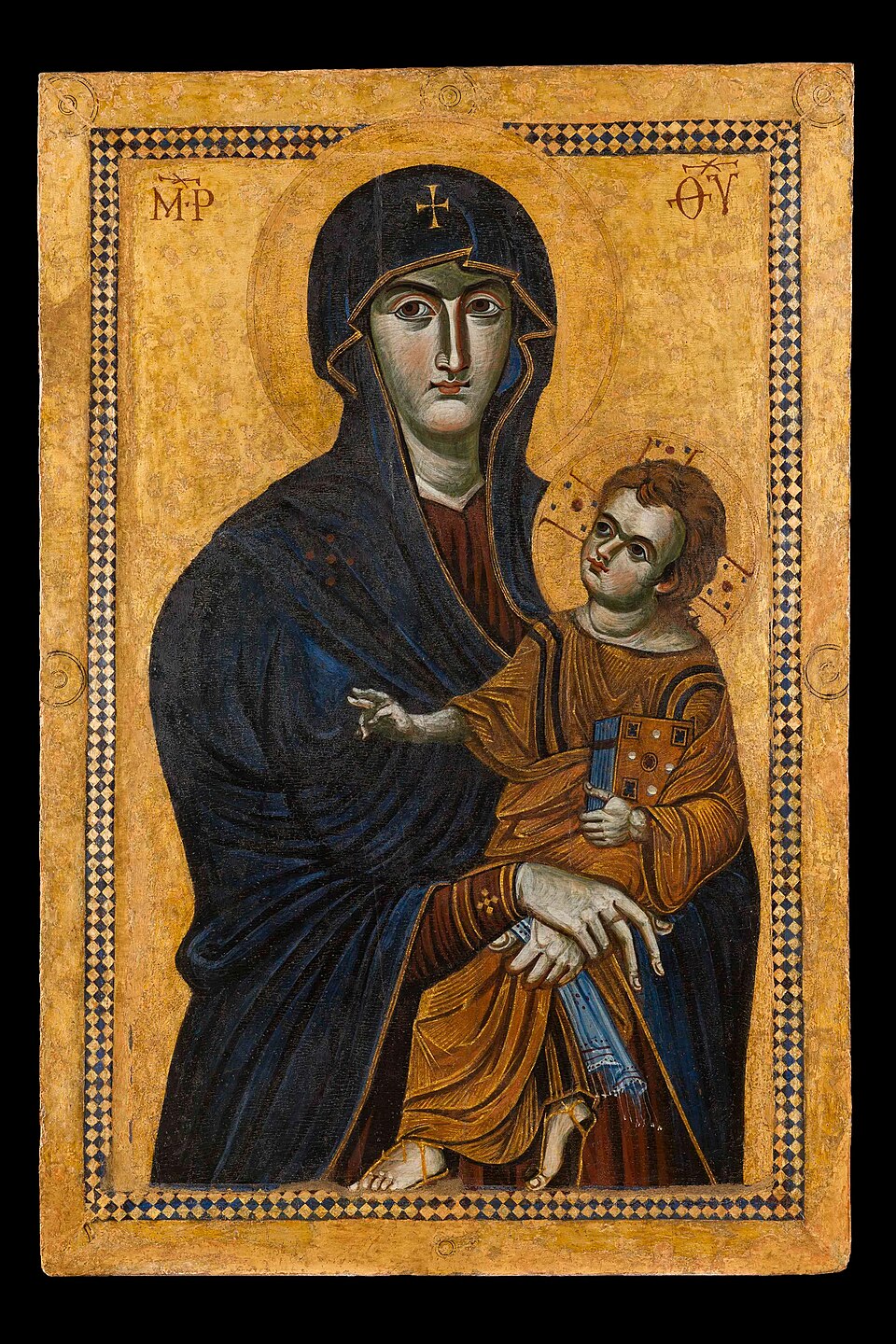
Mary, Mother of the Church⁴
Nuptial Longing
The whole Holy Scripture is permeated by the pulse of God’s longing love, which knocks ever again at the often so hardened and closed hearts of the children of men, in order to draw them to Himself in mercy. This nuptial love reveals itself especially impressively in the image of the wedding, which God already prepared in the Old Testament and which, through Jesus Christ, who came into this world as the Messiah and Bridegroom, was solemnly accomplished in a wonderful exchange of love.
I will betroth you to Me for ever; I will betroth you to Me in righteousness and in justice, in steadfast love, and in mercy. I will betroth you to Me in faithfulness; and you shall know the LORD. Hos 2,21-22 (RSV-CE 2,19-20)
The wedding is the deepest mystery of the whole visible and invisible creation, and thus also the deepest mystery of the Church, which goes to meet her Bridegroom on the pilgrim way of this time with nuptial longing.
Painfully moved by the grave distresses which threaten and deeply wound our Mother Church from within and without, we want, with this small brochure, to cast sparks of longing for the heavenly wedding into many human hearts, so that their love for Christ may be kindled anew in the mystery of His mystical body, and that they may go forth with burning lamps to meet the Bridegroom and the Bride. (cf. Mt 25,1-13)
A countless host of saints has already reached perfection on this way to the heavenly wedding and now prays for us before the throne of God, that we too may one day be allowed to come into this great banquet hall of the eternal joy of heaven.
If we cast a look into the lives of the saints, we are drawn into an atmosphere of divine grace, which literally shines from the eyes of these souls who are in love with God. They have allowed themselves to be completely transformed by the nuptial mystery of God’s love and have been immersed in such a happiness that the earthly-minded world does not even suspect it.
In the following chapters, some of these shining pillars of fire of the Church take us along on the way to God, for whose honor and for the salvation of souls they have been completely consumed.
Come, I will show you the Bride! Rev 21,9
Mary, Mother of the Church, we are Yours for time and eternity.
Through You and with You, we want to belong wholly to Jesus now and forever. Amen.
4 Mary as Mother and Patroness of the Church and of the Most Holy Eucharist, and as Queen of the Angels. Surrounded by the seven archangels, Mary stands in the ship of the Church, united with all the faithful in the struggle for the rescue of souls from the evil enemy. The holy angels and the saints of heaven together with the faithful of the Church form the Kingdom of Mary in preparation for Christ’s final victory on earth. (Oil painting by Roswitha Bitterlich)
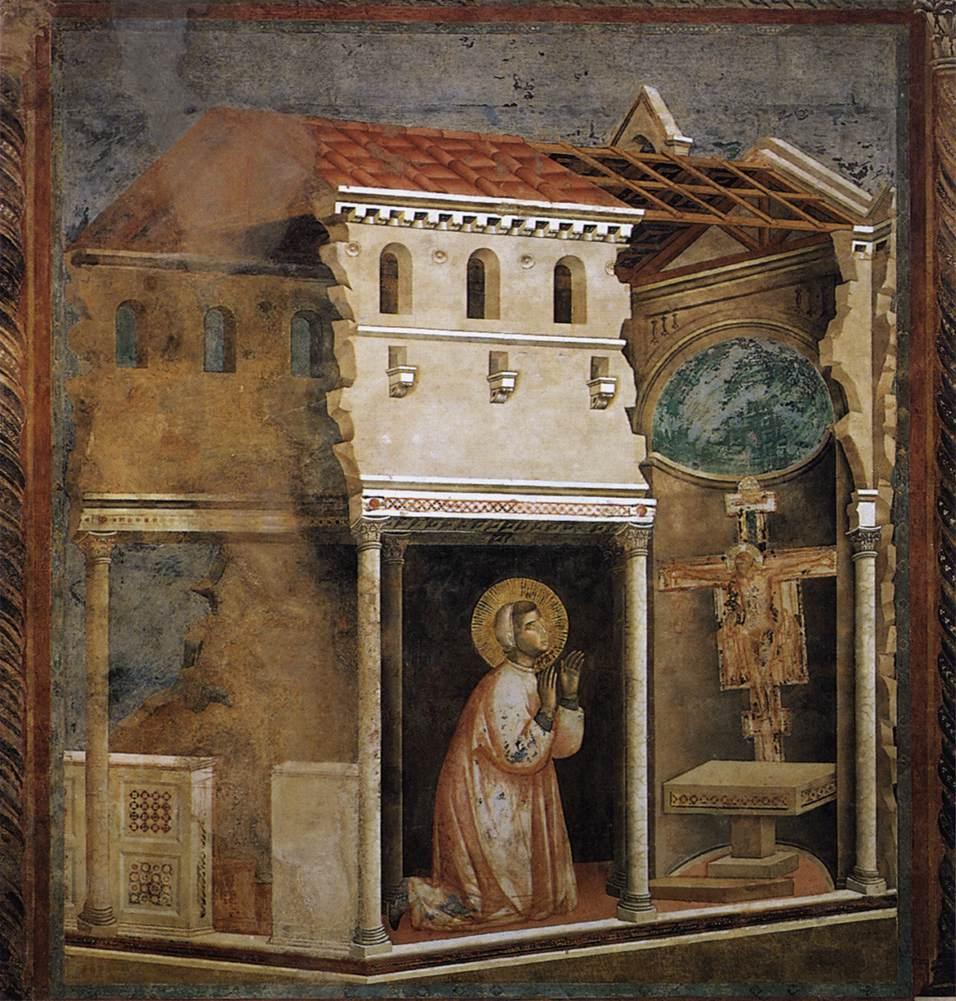
St. Francis prays before the cross of San Damiano.
St. Francis and the Wounded Bride
When St. Francis of Assisi (1181/82 – 1226), led by the Spirit, one day entered the little church of San Damiano to pray, he was struck by unaccustomed visitations of the Spirit, and at once the image of the crucified Christ spoke to him, the lips on the image moving. It called him by name and said: Francis, go and repair My house, which, as you see, is falling completely into ruin! […] From that hour on, when the Beloved had spoken with him, compassion for the Crucified One pierced his holy soul. […] Therefore, from that hour on, he could no longer hold back his weeping. […] He filled the ways with his sobbing, and when he thought of the sufferings of Christ, he allowed no consolation to arise. (2 C 10-11)
The mission that Francis received from the cross: Behold, My house is falling into ruin; go, rebuild it! is a divine word of revelation, in which the whole mystery of St. Francis is contained. At San Damiano he receives this mystery still closed, like the bud of a precious flower. In the little church of the Portiuncula the flower will open for him.
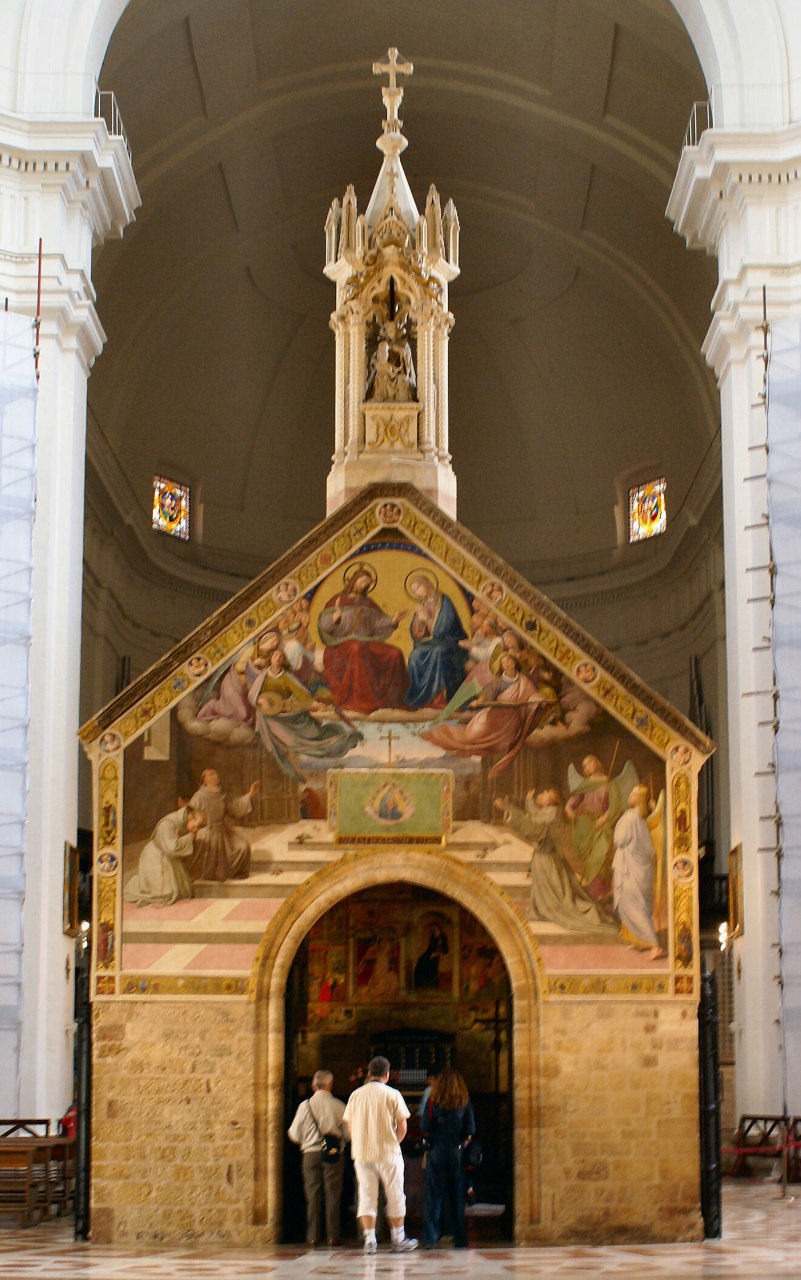
The little church of the Portiuncula in Assisi
St. Francis and Poverty
In the little church of the Portiuncula5 in the year 1209 the Gospel was read, in which the Lord sent out His disciples to preach in complete poverty. (cf. Mt 10,5-16) St. Francis at once rejoiced in the Spirit of God and said: This is what I wish, this is what I seek, this is what I long to do from my inmost heart. (1 C 22)
The mission that was sunk deep into his very being at San Damiano now unfolds for him here at the Portiuncula in the brightest light: he is not only to build houses of stone; he is to lead the living Church of Jesus back to the purity and strength in which the apostles founded her. Therefore he must himself live as the apostles lived. What he had always sought from his inmost heart now takes the form of the promised bride. He has found her, nobler, richer and more beautiful than any you have ever seen. (3 Gef 7) Jesus entrusts to him His greatest and most holy possession: the Church, His bride. House, city, Jerusalem, Zion, Church – all are names of the bride. (cf. Rev 21,2) Francis is to love her as Christ has loved her: in her sins and wounds. Behold, she is falling into ruin. This word touches the whole soul of St. Francis. Christ lives in him His life as Bridegroom and takes him wholly to Himself on the cross. Jesus wounds him with the wound of His own love; he is to “see” with what leprosy the bride, the whole lost creation, is struck, what wounds she tears open in the Body of Christ, and with what love her Bridegroom descends into her poverty to kiss her leprosy and lead her back to her nobility.
Here he discovers poverty as the mystery of the bridal union. He can lead the Church back into the arms of the Crucified One only if he is as poor as the Bridegroom Himself. And thus here, in the little church of the Portiuncula, lies the origin of Franciscan poverty. Francis betroths himself to the bride Poverty.
5 The name “Portiuncula” means “the little part,” “the little portion.” The legend says that a pilgrim brought earth from the Holy Land and scattered it over an area in the forest before Assisi, as far as the earth reached. He dedicated this area to Mary and built a chapel on it for her. It spread among the people that the angels there sang the praises of Mary, and people had often heard it. The saint loved this place more than all others and commanded the brothers to keep it with particular reverence. […] The blessed Father related that God had revealed to him that the Blessed Virgin loved this church with particular love among the other churches built in the world in her honor; therefore the saint also loved it more than all the others. (2 C 18-19)
And the Lord gave me in the churches such faith that I prayed in simplicity and said: “We adore You, most holy Lord Jesus Christ, here and in all Your churches that are in the whole world, and we bless You, because by Your holy cross You have redeemed the world.” (St. Francis)
O wonderful loftiness and amazing condescension! O sublime humility! O humble sublimity, that the Lord of all, God and the Son of God, humbles Himself so far that for our salvation He hides Himself under the unpretentious form of bread. Therefore I ask you all, with all the love of which I am capable, that you show all reverence and all honor, as much as you are able, to the most holy Body and Blood of our Lord Jesus Christ. (St. Francis)
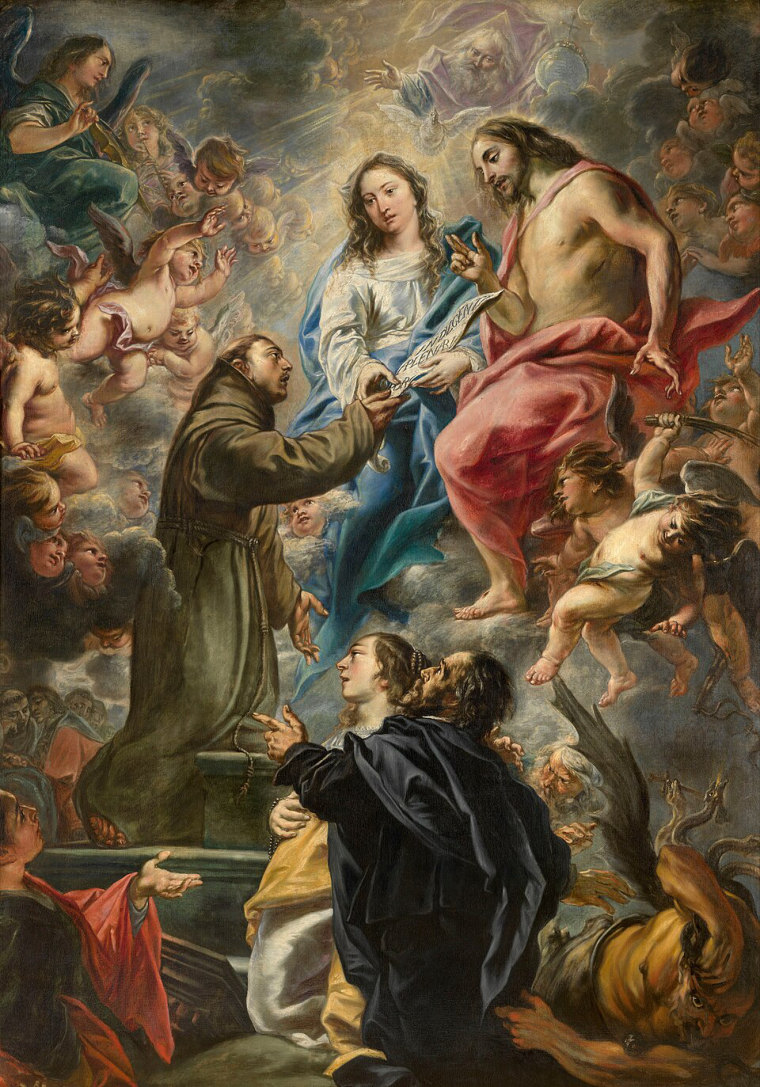
St. Francis receives the Portiuncula indulgence from Christ and Mary (Cornelis Schut)
St. Francis and Chastity
The bridal mystery of the Portiuncula is revealed to us still more deeply in the Portiuncula indulgence.
On a winter night St. Francis was assailed by the most violent temptations against chastity. The temptation was so strong that Francis went out into the cold night, undressed, and threw himself into the thorns of a rosebush. Thus he became master of the temptation. After this victory of fidelity two angels appeared to him, who invited him to come with them to the chapel of the Portiuncula, through whose little window bright light shone. When he entered, he saw above the altar Christ and Mary, surrounded by choirs of angels. He throws himself down on his knees, and Jesus offers him that he may express one wish and hand it over to Mary. He begs that everyone who enters the little church of the Portiuncula in faith should receive remission of all sins and of the punishments for sin. And Mary takes up the request and presents it to Jesus in her nuptial heart. Jesus grants it to her, with the instruction to Francis that he should have this indulgence confirmed by His Vicar on earth, the Pope. Pope Honorius, who at that time was staying in Perugia, granted the indulgence.
But what is the spiritual background of that violent temptation and of the victory in the thorns of the rosebush, which after this struggle for purity lost all its thorns and stood full of blossoms in the middle of winter?
Francis is to lead the Church out of sin back to the bridal blossom; splendid, without spot or wrinkle or any such thing, that she might be holy and without blemish. (Eph 5,27) How can he carry out this mission if he does not keep himself pure in the most violent temptations, and wounds the bride entrusted to him with even the smallest shadow of desire?
God revealed in Paradise the primal enmity between the serpent and the woman who bears the child. (cf. Gen 3,15) In this primal enmity the devil rages, the hater and destroyer of God’s wedding with creation, against Francis, the bride’s escort chosen from among all others. These are battles of world history that he fights and wins in his flesh with the devil. He is the dragon-slayer, who knows from what danger he must rescue the Virgin. (cf. Rev 12,1ff.) Again and again it sounds in his writings like a cry from his heart: And we want to hate our bodies with their vices and sins; for through a carnal life he wants to rob us of the love of our Lord Jesus Christ and of eternal life, and to cast himself into hell together with everyone. (Erm 22)
It is the tears of Jesus over Jerusalem that become bloody in the sore eyes of St. Francis: Would that even today you knew the things that make for peace! (Lk 19,42) Here, in the little church of the Portiuncula, people are to recognize and turn back! When Francis leads countless people through all the centuries to Christian life, it is the fruit of his penance and his weeping.6 In a high point of history God has opened up through Francis the word of revelation about the wedding. He is the herald whom the High Priest sends out from the bridal throne of the cross to invite everything to the royal wedding, so that the whole creation may be led home and wedded in the Blood of Christ. (cf. Eph 1,10; Col 1,16-20) The Church celebrates this wedding feast of the sacrificial death of Christ in every Holy Mass. Take and eat – this is My Body, this is My Blood.
In dying He bowed His head to Mary and John, the nuptial Church, and handed His spirit over to her. At the same time blood and water flowed from His heart. Thus He gave the Church, His beloved bride, His life and all His merits of redemption, so that through Baptism and the Eucharist she might become the mother of all the living.
6 Insofar as perfect continence is thought by many men to be impossible in our times, to that extent priests should all the more humbly and steadfastly pray with the Church for that grace of fidelity, which is never denied those who seek it, and use all the supernatural and natural aids available. (From the Second Vatican Council, Priest. 16)
St. Francis recognized how from the wound in the heart of Jesus the heavenly Jerusalem proceeded, the Church with her sacraments and priestly orders, just as Eve came from the side of Adam. He saw how every flower, every stone, every worm, every cloud in the sky, every star, all of it is the bridal adornment formed from the Blood of Jesus. Every little flower is woven from the love of the divine Bridegroom for His bride, whom He wishes to shower with gifts.
The Christian marriage is founded in this bodily self-giving of Jesus to His bride. (cf. Eph 5,22-32) Therefore it is a sacrament. In the wedding ceremony the bridal couple, in their being man and woman, receive a priestly consecration by the Holy Spirit, so that their conjugal love receives the sanctifying power of the love of Christ.
Pope John Paul II often spoke in his public audiences of the nuptial meaning of the body. Through the body we communicate ourselves, either in sin or in holiness. Therefore every sexual union that does not take place in the holiness of the sacrament is fornication: two people fulfill each other in their being man and woman with their sin and desecrate the temple of God; they dishonor the heavenly wedding that began in Baptism. (cf. 1 Cor 6,15-20)
Our body is to become a holy offering pleasing to God, (cf. Rom 12,1) so that we too can say lovingly to Christ: “This is my body for You!”
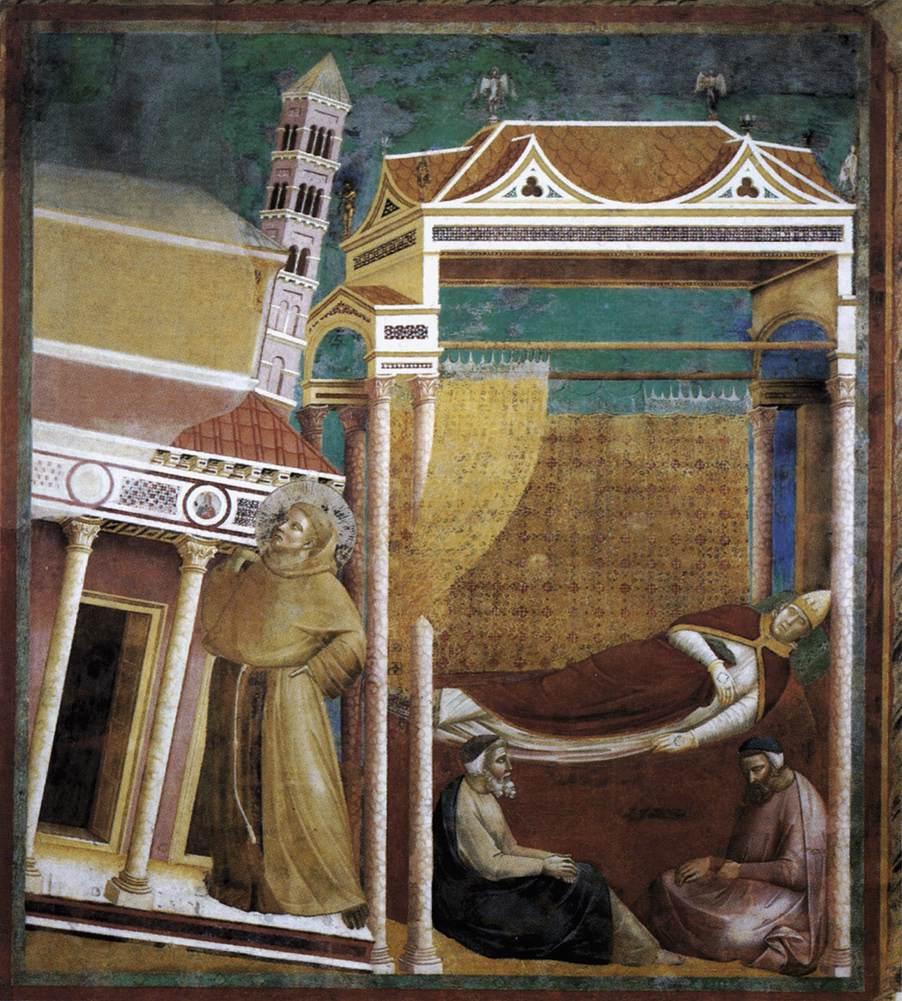
Pope Innocent III sees in a dream a religious man supporting the Church.
St. Francis and Obedience
From where does Francis have his deep veneration and his total obedience to the Church, and indeed to the Roman Church? Aware of the tension between priestly authority and personal holiness, he writes in his Testament: Afterward the Lord gave me and still gives me such faith in priests who live according to the manner of the holy Roman Church, because of their order, that if they were to persecute me, I would still have recourse to them. […] And I do not wish to consider sin in them, because I discern the Son of God in them and they are my masters. And I act in this way since I see nothing corporally of the Most High Son of God in this world except His most holy Body and Blood, which they receive and which they alone administer to others. (Test. 6)
Since the renewal of the Church proceeds to a large extent from the sanctification of priests and consecrated persons,7 Jesus invites us again and again to pray and to offer for this intention. To Maria Sieler, a mystic of our time, who led a life of reparation for the renewal of the priesthood, Jesus said: I want to let the priests share in Me, want to make of them a second Redeemer and Savior, in order to draw suffering and oppressed mankind back to Me. I want to be their life, to become completely one with them, to impart Myself to them. My Heart shall become their heart. (August 19, 1937)8
7 The holiness of priests contributes in the highest degree to the greater fruitfulness of their special service. For although the grace of God can carry out the work of salvation also through unworthy ministers, God nevertheless usually prefers to reveal His miracles of salvation through those who have opened themselves more to the impulse and guidance of the Holy Spirit and who, because of their intimate union with Christ and because of a holy life, can speak with the Apostle: “It is no longer I who live, but Christ who lives in me.” (Gal 2,20) (From the Second Vatican Council, Priest. 12)
8 Josef Fiedler S.J., Erneuerung der Kirche – Maria Sieler, Imprimatur: Vindobonae, die 18.04.1988, Praep. Prov. Austria P. Josef Czerwinski S.J.
A good shepherd, a shepherd after the heart of God, is the greatest treasure that the good God can grant to a parish, and one of the most precious gifts of Divine Mercy. St. John Vianney
In all priests and bishops, and in summary in the Pope, St. Francis sees the priestly presence and authority of the Bridegroom. Herein lies the mystery of the hierarchical Church in her teaching, pastoral and priestly offices.
Jesus entrusted His whole treasury of grace to the Church. This happened symbolically when the body of Jesus was taken down from the cross and laid in the lap of Mary; there she received in her lap all the graces that Christ merited on the cross.
At Pentecost this treasury of grace was implanted into the womb of the Church, and thus the Church was united with Mary. Christ gave the key to this treasure to Peter. He can open and close, bind and loose, with validity also for heaven, which is accomplished especially through the administration of the holy sacraments. Also through the indulgence Mother Church bestows grace on her children in overflowing measure and, in the authority of Jesus, remits to them what they would actually still have to atone for. For just as Jesus in His Incarnation wanted to be wholly dependent on Mary, so in His work of grace He now wants to be wholly dependent on the Church.
Holy Father, keep them in Thy name, which Thou hast given Me, that they may be one, even as We are. Jn 17,11
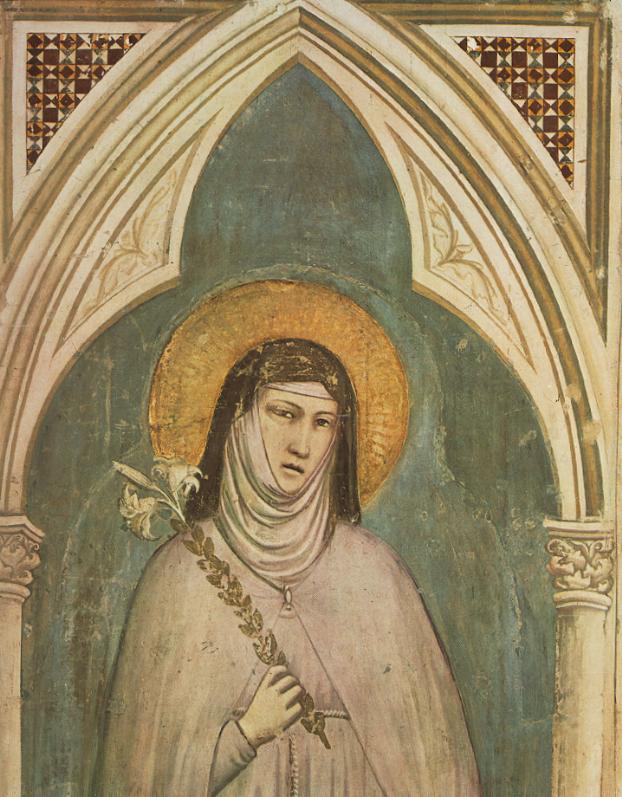
St. Clare of Assisi with the lily (fresco, Giotto)
Clare, the Bride (1193 – 1253)
St. Clare of Assisi, born into a noble family, founded the Order of St. Clare together with St. Francis, by whom she was personally clothed in San Damiano. For forty years Clare will be the woman beneath that cross which spoke to Francis in San Damiano.
… in this strict enclosure, for forty-two years she broke with the scourges of discipline the alabaster vessel of her body, so that the house of the Church was filled with the fragrance of the ointments. (LebKl 10)
Thus Clare becomes the living interpretation of the mission that Francis received from Christ in San Damiano, to rebuild His house. In Clare the Church becomes visible, whom Francis must lead to Christ as a holy, pure bride for the wedding. Therefore St. Francis’ love for Clare is the love of Christ for His Church.9
9 Cf. Eugen Mederlet OFM, Die Hochzeit des Lammes, 1983, pp. 96-133, Imprimatur: Fr. Karl Feusi OFM, Provincial. The Franciscan source writings are taken from Franziskus-Quellen, 2009 and Klara-Quellen, 2013.
Prayer for the Holy Church
Saint Francis, mighty intercessor at the side of Jesus Crucified in His greatest mercy, we beg for your help in our great need. God’s wonderful creation, the world, indeed all of mankind and the holy Church, are in the gravest distress.
Saint Francis, firm pillar of the Catholic Church, once before you supported the tottering walls of the Church; again she is threatened from all sides. Obtain for us unity in faith, so that all who stand outside the Church of Jesus Christ may find their refuge in the arms of Jesus. May they recognize the way home that leads them to fidelity to the Magisterium, anchored in the rock foundation of the Papacy, and to participation in the merits of Jesus Crucified with the riches of all His treasures of grace.
Saint Francis, image of the Passion of Jesus, marked with His wounds, stand by our bishops and priests, that they may fight as protectors and defenders of our faith, confront error, and attain likeness to you. Amen.
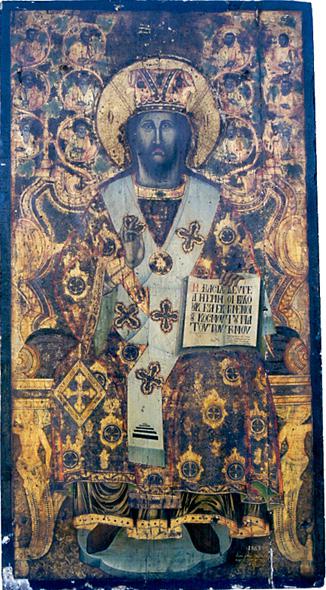
Jesus Christ, the Eternal High Priest
St. Bridget of Sweden (1302/03 – 1373)
St. Bridget, Patroness of Europe, who led a heroic life of sacrifice for the renewal of the clergy and of the whole Church, was repeatedly shown by Jesus His great sorrow over the immoral life of some of His servants.
Once Jesus said to Bridget: Behold, My daughter, when I departed from the world, I entrusted to My priests what was dearest to Me, and I left them five gifts. First, My faith; second, the two keys of hell and of heaven; third, the power to make an enemy of God into an angel; fourth, the authority to consecrate My most holy Body, which no angel can do; fifth, the privilege of being allowed to touch My most holy Body with their hands. But now they treat Me as those who denied that I had raised Lazarus from the dead. […] Today priests do likewise when they do not speak My words and do not proclaim My teaching, but teach the love of the world and preach lust, and count as nothing the guilt of sin they have taken upon themselves.
This complaint of the Eternal High Priest, conveyed to the priests through a saint, did not fail to have its effect on clergy and people.
How much He loves His priests and how He has chosen them, these words to Bridget show us: I have chosen the priests before all angels and saints, and have given them alone the power to make My Body present and to touch it. […] I have loved the priests so much that I wanted to show them such honor alone, and I let them rise to Me on seven steps. They should be patient as sheep, steadfast as a wall on the best foundation, courageous as warriors, wise as serpents; modest as virgins, pure as the angels, glowing with love like a bride who longs for the chamber of her bridegroom.
In a revelation that Bridget receives from the Mother of God, the Pope is reminded to watch over the purity of the clergy: The Pope shall command every bishop to take heed of the life of his clergy, so that everyone who does not wish to amend his life and to persevere in continence shall be wholly deprived of his benefice, because it is more pleasing to God that no Mass be celebrated in such a place at all, than that the Body of the Son of God be touched by the hands of harlots.10
10 Gottes Nordlicht by Ferdinand Holböck, 1983, pp. 293-295, 298, Imprimatur: Archiepiscopal Ordinariate of Salzburg, + Jakob Mayr, Auxiliary Bishop and Vicar General.
St. Catherine of Siena (1347 – 1380)
St. Catherine of Siena, Doctor of the Church and Patroness of Europe, was animated by a quite extraordinary love for the Church. Like her contemporary, St. Bridget of Sweden, she also fought tirelessly with the weapons of the Spirit for the reform and unity of the Church. When one day in a vision the “mystical ship of the Church” is placed on her shoulders, she collapses under the burden. Shortly before her death she prayed:
O eternal God, receive the sacrifice of my life for the mystical body of the holy Church. I have nothing else to offer but what You have given me. Take my heart, then, and squeeze it out over the face of this Bride.11
11 St. Catherine dictated in the years 1377 and 1378, at various intervals, a book that is usually titled the Dialogue of Divine Providence or of the Divine Teaching, in which her soul, in ecstatic conversation with the Lord, reports what the eternal Truth tells her in answer to her questions concerning the welfare of the Church, of her children and of the whole world. The book is characterized by a prophetic spirit, balance of thought and clarity of expression. It deals with the most sublime mysteries of our religion and with the most difficult problems of asceticism and mysticism. Vigilant and imploring, she addresses the brothers in the world, whom she sees being lost on the paths of sin, and whom she tries to rouse from deadly dullness: with fine psychological intuition she casts beams of light on the way of perfection, extolling the elevation of the human being, who in following the obedient Christ finds the sure way to the Most Holy Trinity … (St. John Paul II, from the Apostolic Letter Amantissima Providentia, April 29, 1980)
St. Thérèse of the Child Jesus (1873 – 1897)
St. Thérèse of the Child Jesus, Carmelite, Patroness of the missions and Doctor of the Church, who was consumed by passionate love for Christ and His Church, writes in her autobiography:
I understood that the Church had a Heart, and that this Heart was burning with love. […] Then, in the excess of my delirious joy, I cried out: O Jesus, my Love, … at last I have found my vocation: my vocation is Love! … Yes, I have found my place in the Church, and it is You, my God, who have given me this place. … In the heart of the Church, my Mother, I shall be Love, … thus I shall be everything, … thus my dream will be realized! … I am only a child, weak and powerless, and yet it is my weakness which gives me the boldness to offer myself as a victim of Your Love, O Jesus! […] I want to let no little sacrifice escape, no glance, no word, wishing to profit by the smallest actions and do them through love … O my Jesus! I love You, I love the Church, my Mother, and I recall that the least stirring of pure love is of more benefit to her than all other works together.
Prayer for Priests
O Jesus, Eternal High Priest, keep Your priests in the shelter of Your most Sacred Heart, where no one can harm them.
Keep unstained their anointed hands, which touch Your most holy Body daily.
Keep pure the lips, which are reddened by Your precious Blood.
Keep pure and unearthly their heart, which is sealed with the sublime sign of Your glorious priesthood.
Let them grow in love and fidelity to You, and shield them from the contagion of the world.
Give them, with the power of transformation over bread and wine, also the power of transformation over hearts.
Bless their works with abundant fruit, and grant them one day the crown of eternal life. Amen.12 St. Thérèse of the Child Jesus
12 The basis of her prayer and sacrifice was for Thérèse a great esteem for the priesthood. Although she noticed the weaknesses of priests, she does not simply turn to criticism. Rather, this is for her an occasion to pray and to offer sacrifice. And at the examination that preceded her profession, she said: “I have come to save souls and especially to pray for priests.” (From Thérèse of Lisieux, Autobiography, 1988)
Blessed Dina Bélanger (1897 – 1929)
The mission of Blessed Dina, of the Sisters of Jesus and Mary in Sillery (Canada), consisted above all in a life of reparation for the sanctification of priests and consecrated persons. To her too the Lord revealed His great love for consecrated souls, but also His deep sorrow over their unfaithfulness.
My priests, My priests, alas! I love them so much! And among them there are so many who love Me so little! … If My Heart has shed tears of blood over them in the Agony, this did not happen only because they have separated themselves from Me through the loss of sanctifying grace, but also because they do not lead enough a life of intimate union with Me. I call them to become another Christ; to be another Me: that is their vocation. Many of them are My comfort, My glory and My honor. But some, alas, grieve Me … Will you, My little bride, give Me your today through My most blessed Mother for My priests? Will you give it to Me every Saturday? That is, to love Me through My sublime Mother, to pray, to deny yourself, to offer yourself for My priests? […]
In the hands of My priests lies the whole religious life of society. If they were all truly holy, the mere sight of them, whether in the church, on the street or elsewhere, would turn people’s thoughts to Me; they would draw souls to Me; if one met them, one would think: that is another Christ, walking there! […]
If you knew how much My Heart is consoled when I find a soul that surrenders itself to Me completely! But of these I find so few! Even among consecrated souls those who surrender themselves to Me completely are rare! – My apostles Peter, James and John, to whom I had just given Myself in Holy Communion and whom I had made priests, were consecrated souls, and they slept during My Agony! How many consecrated souls still sleep, while My Church is persecuted and suffers.
Dina gains deep insights into the mystery of the Most Holy Sacrament of the Altar. If we understood what a treasure we possess in the divine Eucharist, the churches would be filled day and night with adorers, who are consumed with love for the divine Prisoner of the tabernacle.
My Heart overflows with graces for souls. Lead them to My Eucharistic Heart! Jesus to Blessed Dina
The Lord also reveals to Dina profound mysteries about the blessedness of heaven and the ineffable worth of the Cross.
Dina sees that the least degree of blessedness in heaven outweighs infinitely all imaginable joys on earth. And every smallest act of love, of conformity to the divine will, of obedience or of renunciation will bring us such blessedness. The Most Holy Trinity offers us the abysses of its riches, but how small is the number of those who receive them by surrendering themselves completely to the holy working of God.
We will never be able to grasp the immensity of infinite goodness toward every human soul. The longest life here on earth in reality lasts only a brief moment. How senseless we are if we do not use this moment, which is our earthly life, for the greater honor of the Most High Lord. What surprises there will be at the last hour, when the veil is torn away to reveal the truth! […]
I would gladly make clear to all souls, especially to the chosen souls, the worth of the Cross. Suffering is an immeasurable gold mine; it is a burning arrow that love shoots from the Heart of the Infinite, in order to consume the human heart and to immerse it in the Godhead. […]
No, the heart of this adorable Bridegroom, which is so tender and good, is not recognized! Jesus has chosen the Cross as a holy good. He has embraced it with passion; He has loved it to the point of folly: and that for us! […] How greatly His Heart rejoices when a wounded and crucified soul kisses with love the scourge, the lance and the precious nails! […] O Spirit of Truth, through the merits of Jesus I beg You: grant souls the light, teach them to esteem the true goods and to acknowledge infinite goodness in the hours of trial and humiliation.13
O Jesus, Eternal High Priest, who out of love for us redeemed mankind through Your suffering and Your death on the cross, graciously accept my suffering through the blessed hands of Your Mother. With Your cross I offer You mine in love. Make fruitful the apostolate of Your priests, so that Your kingdom of light, love and peace may come to us. Amen.14
13 Die Selige aus Kanada by Engelbert Recktenwald, 1996.
14 Imprimatur: Frib. Helv., September 15, 1960.
Sr. Consolata Betrone (1903 – 1946)
The mission that Jesus entrusted to the Servant of God, Sr. Consolata of the Order of the Capuchin Poor Clares, consists in cooperating, through the “Little Way of Love” to which she calls souls, in the religious renewal of the world and in the salvation of souls. This spiritual path, as becomes clear from the teachings of Jesus, can be summed up in three points:
- An unceasing act of love – the prayer of the heart, that is, an inner act.
- A smiling yes to all: to see Jesus in all and to treat all as Jesus does.
- A thankful yes to everything: to all that God wills of us.
The life of Jesus on earth was a continual struggle for the salvation of souls. The Lord speaks to Sr. Consolata of this longing that strives:
Love and souls! What is more beautiful? […] Jesus, Mary, I love You, save souls! Include all: the souls in purgatory as well as those of the Church militant, the innocent as well as the guilty, the dying, the godless, all souls!
Jesus entrusted to Sr. Consolata in particular those consecrated persons who have become unfaithful to their vocation. Thus He explained to her:
Consolata, you too have in the Church a flock that you are to lead to eternal life: your brothers and sisters. Come, you too shall be a good shepherd, who like Jesus lays down his life for his sheep.15
Mary, good Mother of priests, take all priests under Your special protection and shelter, and with a kind motherly hand lead also the poor erring priests who have become unfaithful to their lofty vocation back to the Good Shepherd. Amen.16
For these her brothers and sisters Consolata did everything. She constantly prayed her prayer of the heart at all her tasks: Jesus, Mary, I love You, save souls!, and made everything into a sacrifice for God. For this Jesus gave her the promise:
Behold, these are altogether insignificant things, but I rejoice greatly over them and give them immeasurable value, because you offer them to Me with great love. All these trifles I let stream down as graces of conversion upon our unhappy brothers.
Often very concrete grave cases were entrusted to the convent, for which Consolata took over the corresponding sufferings in their place. Thus she sometimes endured for a longer time dryness, abandonment, meaninglessness, loneliness, doubt and the sinful states of priests. Once she wrote to her spiritual director in this struggle: How much the brothers cost! But Jesus gave her the magnificent promise:
Consolata, you will go in search of every brother and every sister and bring them back to Me, and I will forgive them for the sake of the Blood that I have shed for all.17
There must be no brother in the world, however much he could have sinned, who, after he has looked into your eyes, would have to depart without your mercy, if he is looking for mercy. And if he is not looking for mercy, ask him whether he wants mercy. And even if he were to sin a thousand times before your eyes afterward, love him more than me, so that you may draw him to the Lord. St. Francis
15 Judas unfortunately did not remain alone; he was only the first of a long line that continues to this day. All these unhappy ones are the cause of the thorns around the Divine Heart of Jesus and of the bitterest tears of the Church, who very much wishes that all the faithful cooperate through prayer and sacrifice in the sanctification of priests and consecrated persons. Many indeed complain about these scandals and throw stones at the straying sheep, but only few help to lead these unhappy ones back to the Good Shepherd. Let us not forget that every little ejaculatory prayer and every small sacrifice in this intention is a pearl and a sign of our mutual love and responsibility.
16 Imprimatur: Regensburg, February 1, 1973.
17 Cf. Schwester Consolata Betrone by Fr. Lorenzo Sales, 1961, Imprimatur: Friburgi Helv., September 15, 1961.
The Holy Mass – the Sun of Our Life
Among all the treasures of the world none is more precious than the Holy Sacrifice of the Mass; and among all the misfortunes of the world none is greater than ignorance of this most holy Sacrifice. For in the celebration of the Holy Mass we stand as members of the mystical body, as it were, at the foot of the cross, and, united with Christ, our Eternal High Priest, we may offer to the Heavenly Father the perfect sacrifice of praise, thanksgiving, atonement and petition. The Holy Mass is therefore the source and summit of the whole Christian life, the highest worship, the mysterious unbloody making present of the sacrifice of Jesus Christ on the cross.
I beg also in the Lord all my brother priests, who are priests of the Most High […]: whenever they wish to celebrate Mass, they shall offer the true sacrifice of the most holy Body and Blood of our Lord Jesus Christ, being themselves pure and with a pure intention, with reverence and with a holy and pure purpose. St. Francis
In the obedient self-surrender of Jesus, all glory and honor is given to the Father. At the same time, the love of Christ opens for every human being a way that leads to the heart of the Father. Thus in this mystery there shines forth the deepest attribute of God, His unfathomable mercy. We lay our whole being, our human weakness, our cares and needs, as well as the guilt of all men, into the transforming event of the Holy Mass. For in the offered Body and in the poured-out Blood of Christ we find healing and atonement for our sins and the sins of the whole world.
Of the Holy Mass one can say what Holy Scripture says of wisdom: It is an unfailing treasure for men; those who get it obtain friendship with God. (Wis 7,14)
No hour of the day is more precious than the hour in which we take part in the Holy Mass. This time is in truth a golden hour. The sacrifices that we take upon ourselves when we take part in the Holy Mass are turned into gold. For just as the sun surpasses all the planets, so devout participation in the Holy Mass surpasses all other works of piety.
Nothing can equal the greatness of the Eucharist! Set all the good works of the world against one good Communion – it is like a grain of dust beside a mountain range. St. John Vianney
At the moment when the Holy Mass is celebrated, the angels of heaven hasten to the prison of purgatory and open it. St. John Chrysostom
When St. Pio was once asked what we should do at the Holy Mass, the saint answered: To suffer with and to love. He also used to say: The world could sooner exist without the sun than without the Holy Mass.
O Jesus, through Your death and Your holy Blood, convert sinners, save the dying, deliver the Poor Souls from purgatory, sanctify priests, religious and families.
At every celebration of the Holy Mass the call of the Heavenly Father rings out: Everything is ready; come to the marriage feast! My beloved Son renews through the hands of the priest the sacrifice of Calvary and feeds you in the Most Holy Eucharist with His own Flesh and Blood! And yet, how few only follow His invitation – But they made light of it … Thus it is written in the parable of the royal wedding feast, which we want to consider vividly and true to life in the following chapter.
Come to the Marriage Feast!
Christ is the only-begotten Son of God. In His Incarnation He comes to call His bride, the holy Church, to the wedding, and to invite men to the celebration. The parable names four groups of those invited:
The first group are the indifferent. There are such also among those invited by God. The invitation is extended to them several times with emphatic insistence. But religion means nothing to them. They are realists, for whom only the earthly and the material is a reality. Christianity does not interest them. […] It has nothing to do with stock-market speculation, professional advancement and social standing. The invitation remains unattended on the desk or ends up in the waste-paper basket. In reality, however, there is no indifference toward God, for God does not accept it. Whoever does not care about Christ does not come into the Kingdom of God; he is therefore one who stands outside and accordingly remains outside. The final judgment of the Lord will be: I do not know you!
The second group are the people of opposition. In the parable they simply kill the messengers who bring the invitation. They side neither with the reigning sovereign nor with the heir to the throne. […] They are clearly in the other camp. Regarding the question of the Kingdom of God, they are the militant atheists, the haters of Christianity. Religion is for them no matter of indifference, but opium for the people, an obstacle to the advancement of mankind, an enemy of true humanity, a hindering remnant of the superstitious Middle Ages, which must finally be eliminated. Thus they wage the battle in word and in writing, join together for common action and organize resistance. In the parable the king’s reply is not long in coming. His troops surround the seat of the hostile resistance, level it to the ground and kill the enemy. It is a picture of the great reckoning of Christ at the end of time.
The third group are the irreverent. The parable portrays a single figure as their representative. The man who was invited from the street to the wedding, and to whom a festal garment was offered in the vestibule, is convinced that his rags are good enough. He should be taken as he is. The invitation means nothing special to him. Applied to the spiritual realm, these are the people who do not want to know what matters to God. They lack the fear of God. […] Religious life is something to which one gives expression from time to time, more under compulsion than voluntarily. One goes to Sunday Mass in the morning, just as one goes to lunch in a restaurant, or in the evening to a concert, and on weekdays to the office. God must be glad when they follow the invitation to divine worship. These are the people who have never truly grasped inwardly what a call from God means. The difference between Creator and creature, eternity and time, infinity and finitude, Lord and servant has never become truly alive for them. […] Therefore they make no effort at all to cultivate a corresponding inner attitude. They do not see that a Christian lives differently from a non-Christian. Because God is for them something incidental, they also do not care whether they live in the grace of the Lord or in sin. […] The consequence is shown drastically in the parable. It is the casting out from the illuminated festal hall into the darkness, from election into rejection. Outward membership in the Church of Christ is not enough. If the inner transformation does not take place, everything ends in being cast out.
The value of a single grace is greater than the value of the whole universe. St. Thomas Aquinas
The fourth group are the true wedding guests. They are, to be sure, of strange origin: vagrants, tramps, simple folk and beggars from the hedges and fences. The invitation was the great surprise of their lives. Joyfully they have followed it. With shudders of reverence they have entered the palace, and with childlike joy they have put on the festal garment given to them. And now they are at the wedding celebration as if in heaven. Only one thing do they fear: ever having to go back out into the filth and misery, into the cold and darkness outside. These are the people of radiant eyes and grateful hearts, the people who know what grace and vocation are. It is the sinful man who has been called into the world of grace. It is the religious man, who knows that without God everything is worth nothing, who knows how to value the calling as a freely given grace, and who carries deep within himself the painful experience of his own weakness and sinfulness. Yet everything is lost in the splendor of festive joy, for he knows that Catholic Christianity is a wedding celebration that began with the Incarnation of God and that will reach its full festive height at the Lord’s return, with a light that never goes out and a joy that never fades.
Thus Christianity demands a decision, for or against, a Yes or a No. […] At stake is the ultimate and deepest matter, eternal being or non-being.18
Heavenly Father, I offer You through Mary the infinite merits of Jesus, in reparation for all the graces I have squandered. Amen.
18 Richard Gutzwiller, Die Gleichnisse des Herrn, 2017, Imprimatur of the Episcopal Ordinariate of Chur, March 2, 1960.
The Mother’s Tears
Weeping, with her face hidden in her hands, the Mother of God appeared on September 19, 1846 to two shepherd children at La Salette.
I am here to tell you an important message … If my people will not submit, I am forced to let fall the arm of my Son. It is so heavy and so oppressive that I can no longer hold it back. For so long I have suffered for you, and you take no account of it! … Six days I have given you to work, the seventh I have kept for myself, but they refuse to grant it to me.19 That is what makes the arm of my Son so heavy … If the harvest is spoiled, it is only because of you … If they convert, the stones and rocks will turn into heaps of wheat, and the fields will be covered with potatoes …
Ah, children, you must say your prayers well, even if it is only one “Our Father” and one “Hail Mary” in the morning and evening, if you have no more time. But if you have more time, then pray more! In summer only a few old women go to Holy Mass. The others work on Sundays all through the summer. And in winter, when they do not know what to do, they go to Holy Mass only to make fun of religion …
Throughout the whole time of the apparition the tears run from the eyes of the Mother of God.20
Our Lady of La Salette, Reconciler of sinners, pray without ceasing for us who take refuge in You!
19 According to God’s will all the graces merited by Christ are granted to us through Mary. So also the days that God grants us pass through Mary’s hands. (cf. Leo XIII, Encyclical Octobri Mensae) Therefore Mary could say at La Salette: “Six days I have given you to work.”
20 On September 19, 1851 the message of La Salette was officially recognized by Philibert de Bruillard, Bishop of Grenoble. How very different is the divine strategy of salvation from today’s renewal programs. Through the Mother of God the Lord does not demand a loosening of the moral teaching of the Church, but penance and conversion; not a reduction of Marian devotion for the sake of ecumenism, but the veneration of her Immaculate Heart. Toward a Padre Pio the Lord does not demand the abolition of celibacy or liturgical experiments to enliven the worship, but He complains of the indifference and irreverence shown to Him in the Most Holy Sacrament of the Altar. Toward the Blessed Dina Bélanger the Lord does not demand greater openness to the world from His priests, but a life in more intimate union with Him, and from the orders and communities no softening of discipline, but greater fidelity to the Holy Rule. In the messages to St. Sr. M. Faustyna the Lord proposes no reduction of the awareness of sin, but invites us to avail ourselves often of His mercy in the Holy Sacrament of Penance. What is praised today as progress is in reality the demolition of the teaching of faith and morals. And this demolition pierces the Heart of Jesus and of Mary. (cf. Engelbert Recktenwald, Harter Geist und weiches Herz, Imprimatur: Fr. Josef Bisig, Suprio generalis, FFSP, Opfenbach, October 21, 1996)
A Silent Guide to the Catholic Faith
The Steyler missionaries Father Götsch and Brother Gervasius had an experience in China that defies all rational comprehension.
Brother Gervasius accompanies the Father from Kaotai to a woman who is critically ill. After a three-day ride of more than two hundred kilometers they reach their goal, but the sick woman had already died. Downcast, the missionaries begin the journey home. About halfway up the mountain ride they meet a boy, who asks them to come along to his mother. The boy leads them about 15 km off the road to a small village. In a clay hut a dying woman is waiting. Suddenly she puts strange questions to the two missionaries:
“Stranger, will you answer me truthfully?”
“Certainly.”
“Is there a God in whom there are three forms? Is there in the next life a place of joy for the good and a place of terror for the wicked? Is it true that God came to this earth to die for men and to open for them the place of joy? Foreigner, is all this true?”
The priest answers all these questions in the affirmative, amazed. How does the sick woman know these truths of faith?
“You have water with you,” the sick woman continues, “wash me, so that I may come to the place of joy!”
How does she know that Father Götsch has baptismal water with him? After a short conversation the missionary baptizes the sick woman. Full of joy the mother expresses a new wish: “You have bread with you. Not ordinary bread, but God Himself. Give me some of it too.”
The dying woman also knows that the priest has the Most Holy Sacrament with him. Father Götsch gives her Holy Communion and administers the Anointing of the Sick.
Then he says: “Until now you have asked questions; now I ask some questions: How do you know the truths of faith? Did Catholic or Protestant Christians tell you about them?”
“I know no Christians, stranger!”
“Did you read all this in books?”
“I cannot read. I also do not know that there is Christian literature in my language.”
“But then where does your knowledge of the faith come from?”
“I simply thought it must be so. For ten years I have lived according to this faith. I have also taught my children. You can ‘wash’ them all” (she means baptize).
“Did you know that we would come by today?”
“Yes, I had a dream and saw an older man, who told me I should send my boy to the road and call the two foreigners, they would ‘wash’ me for the good place after death.”
The missionaries are deeply moved. The sick woman’s manner, in the face of death, is so simple that no room is left for doubt. As a farewell they give her a small picture of St. Joseph, the patron of the dying. Then the sick woman is beside herself with joy. “I know him, he has visited me. He has been with me often and let me send my son on the way to call you.”
Was he with her in a dream or in reality? She does not know, and it is not important to her. What matters is what she has learned through him.
The woman died that very night.21
Loving St. Joseph, powerful protector after the holy Church, look upon the great distress of the Bride of Jesus Christ and the terrible need of so many souls. O come to their aid with Jesus and Mary, the angels and saints. Confound the plans of the godless and kindle the hearts of the faithful with the fire of the Holy Spirit, so that they may freely and openly confess Jesus, fight for the concerns of the Kingdom of God and conquer. Amen.22
21 According to a report by Ludwig Lenzen from “Weite Welt,” No. 1, January 1976.
22 Imprimatur: Regensburg, March 13, 1977.
The Fish in the Net of the Church
Many people are heavily influenced by our entirely this-worldly and faithless society and, mostly compelled by the law of sin, (cf. Rom 7,23) detach themselves from the sacramental life-stream of the Church. Yet despite all the apparent “freedom”23 in whose name especially moral and religious values are thrown overboard, deep sadness and loneliness reign in many hearts. For when we take leave of the commandments of God and His Church like defiant children, we ultimately stand before the chaos of a failed life.
O unjust world! You do everything to drive Me from the face of the earth, to banish Me from society. […] You forge intrigues as to how you can destroy My Church and kill her servants. […] And I will shame you with My love. […] The word “Will of God” alone contains an eternal wonder, to which nothing can compare. […] My will contains the substance of all joys, the source of all happiness. Jesus to the Servant of God Luisa Piccarreta
23 That this “freedom” ultimately makes us slaves is shown to us by the words of Jesus in the Gospel of John. “If you continue in My word, you are truly My disciples, and you will know the truth, and the truth will make you free. […] Truly, truly, I say to you, every one who commits sin is a slave to sin. The slave does not continue in the house for ever; the son continues for ever. So if the Son makes you free, you will be free indeed.” (Jn 8,31-36)
If we increasingly “forget” God, the only source of all joy, and move away from His most holy will, then our conscience gradually darkens and faith fades. For faith and sin cannot remain good neighbors in the long run, and because one loves sin and does not want to let go of it, faith must give way.
In view of this truth St. Paul preaches: Keep faith and a good conscience. By rejecting conscience, certain persons have made shipwreck of their faith. (1 Tim 1,19)
One no longer practices as a Catholic, rails vigorously against religion and the Church, doubts the basic truths of Christianity, and finally becomes Protestant overnight or leaves the Church for good. On this subject St. Cyprian remarked: Let no one believe that the good could leave the Church. The storms blow away chaff and straw, not the wheat.
When a young man boasted before the philosopher Pascal that he no longer believed, the latter answered him: “Cast off sin, and tomorrow you will believe again.”
Even if the “children of this world” no longer want to hear the teaching of the Church and her moral demands, all shepherds and faithful are nevertheless called to stand firm and faithful to the true Catholic faith. Especially those priests who hold fast to the love of the Lord and His truth go, to be sure, the way of martyrdom, but they keep their dignity despite many trials and at the same time become a blessing for a great number of souls that God has entrusted to them. Like John the Baptist they fight for the indissolubility of marriage and thereby draw upon themselves the hatred of “Herodias” – “the world.” Like Stephen, they bear witness to the truth of Christ and thereby fall into the most violent battles: Now when they heard these things they were enraged, and they ground their teeth against him. (Acts 7,54) And like the blessed martyr priest Otto Neururer, who was murdered by the Nazis because he clearly spoke out against the marriage of a young woman to a divorced Nazi officer who had left the Church, so also the faithful priests are persecuted, if not bodily, then spiritually and inwardly, for the sake of the holy Gospel. Countless examples could be cited here, which show us clearly: Jesus does not abandon His Church, because she is His beloved bride and because He has shed His last drop of blood for her. From His pierced Heart flows the nuptial wine of the holy sacraments, whose fruits we rob ourselves of for time and eternity when we deny our Catholic faith.
It is precisely this grave loss of faith and of the moral values, which in recent decades have largely collapsed, that plays a decisive role within the tragic abuse scandals that inflict deep wounds on the mystical body of the Church.24
Today bring to Me the souls of heretics (those who have lost the true faith) and schismatics (those who have left the Church), and immerse them in the ocean of My mercy. In bitter suffering they tore My Body and My Heart – that is My Church. When they return to the unity of the Church, My wounds are healed, and thus they lessen My sufferings. Jesus to St. Sr. M. Faustyna
24 While Christians are dying for their faith and their fidelity to Jesus, in the West, men of the Church are trying to reduce the requirements of the Gospel to a minimum. We even go so far as to use the mercy of God and to smother truth and justice. […] The true scandal is not in fact the presence of sinners, since for them there is always mercy and forgiveness, but the lack of clarity regarding good and evil, […]. When consecrated men are no longer able to understand the radicalism of the message of the Gospel, and try to lull it to sleep, then we will go astray. For here we have a real violation of mercy. […] Today there is a confrontation and a rebellion against God, an organized struggle against Christ and His Church. […] (Robert Cardinal Sarah, Gott oder Nichts, 2015)
Encouraging Words from Pope Emeritus Benedict XVI
In a profound overview, Pope Benedict XVI gives us, in his published letter, clear and encouraging impulses for a new beginning of the Church, which can be oriented solely toward obedience and love for our Lord Jesus Christ. We quote here a small excerpt from this letter:
A first task, which must result from the moral upheavals of our time, is that we ourselves once again begin to live by God and unto Him. Above all, we ourselves must learn again to recognize God as the foundation of our life. […]
God became man for us. Man, His creature, is so close to His heart that He has united Himself with him and has thus entered human history in a very practical way. […] We talk about this in detail in theology, with learned words and thoughts. But it is precisely in this way that we run the risk of becoming masters of faith instead of being renewed and mastered by the faith.
Let us consider this with regard to a central issue, the celebration of the Holy Eucharist. Our handling of the Eucharist can only arouse concern. The Second Vatican Council was rightly focused on returning this sacrament of the presence of the Body and Blood of Christ, of the presence of His Person, of His Passion, Death and Resurrection, to the center of Christian life and the very existence of the Church. In part, this really has come about, and we should be most grateful to the Lord for it.
And yet a rather different attitude is widely dominant: what predominates is not a new reverence for the presence of the death and resurrection of Christ, but a way of dealing with Him that destroys the greatness of the mystery. The declining participation in the Sunday Eucharistic celebration shows how little we Christians of today still know about appreciating the greatness of the gift that consists in His real presence. The Eucharist is devalued into a mere ceremonial gesture when it is taken for granted that courtesy requires it to be offered at family celebrations or on occasions such as weddings and funerals to all who are invited for family reasons. The way in which, in some places, those present simply receive the Holy Sacrament as a matter of course shows that in Communion one sees only a ceremonial gesture.
So when we reflect on what must be done, it becomes clear that we do not need another Church of our own design. What is necessary is rather the renewal of faith in the reality of Jesus Christ given to us in the sacrament. […]
The crisis caused by the many cases of abuse by priests urges us to regard the Church almost as something failed, which we must now thoroughly take in hand ourselves and reshape. But a Church made by ourselves cannot be a hope.
Jesus Himself compared the Church to a fishing net in which there are good and bad fish, which at the end must be separated by God Himself. Beside this stands the parable of the Church as a field on which the good grain grows, which God Himself has sown, but also the weeds that “an enemy” secretly sowed there as well. Indeed the weeds in the field of God, the Church, are excessively visible, and the bad fish in the net also show their strength. But nevertheless the field remains God’s field and the net remains God’s fishing net.
And in all times there are not only the weeds and the bad fish, but also the seed of God and the good fish. To proclaim both with emphasis is not a false apologetics (defense), but a necessary service to the truth.
In this connection it is necessary to refer to an important text in the Revelation of John. The devil is there marked as the accuser, who accuses our brothers before God day and night. (Rev 12,10) The Apocalypse thereby takes up again a thought that stands at the center of the frame narrative of the Book of Job. (Job 1 and 2,10; 42,7-16) There it is told that the devil tried to disparage before God the righteousness of Job as merely outward. […] For Christians it is clear that Job, who stands before God as an example for the whole of mankind, is Jesus Christ. In the Apocalypse the drama of man is presented in its whole breadth. Against the Creator God stands the devil, who disparages all mankind and the whole creation. He says not only to God, but above all to men: Look at what this God has made. Supposedly a good creation. In reality it is in its totality full of misery and disgust. The disparagement of creation is in reality a disparagement of God. […]
Today, in the accusation against God, it is above all a matter of disparaging His Church as a whole and thus turning us away from her. The idea of a Church made better by ourselves is in reality a suggestion of the devil, with which he wants to turn us away from the living God through a lying logic into which we all too easily fall. No, the Church today also does not consist only of bad fish and weeds. The Church of God exists today as well, and it is precisely today the instrument through which God saves us. It is very important to set against the lies and half-truths of the devil the whole truth: yes, there is sin and evil in the Church. But there is also today the holy Church, which is indestructible. There are also today many humbly believing,25 suffering and loving people, in whom the real God, the loving God, shows Himself to us. God has today also His witnesses (“martyres”) in the world. We only have to be awake in order to see and to hear them.
The word martyr is taken from procedural law. In the trial against the devil, Jesus Christ is the first and true witness for God, the first martyr, after whom countless others have followed. The Church of today is more than ever a Church of martyrs and thus a witness of the living God. If we look around and listen with a watchful heart, we can find everywhere today, especially among simple people, but also in the high ranks of the Church, the witnesses who with their life and suffering stand up for God. It is a sluggishness of the heart that we do not want to perceive them. One of the great and essential tasks of our proclamation is, as far as we can, to create habitats of faith and, above all, to find them and to recognize them. […]26 Pope Emeritus Benedict XVI
25 When Jesus warns at Mk 9,42 against leading “one of these little ones” into evil, He means by this “the simple believers, who can be brought to fall through the intellectual arrogance of those who think themselves clever.” (From the unabridged text, ibid.)
26 kath.net/pl, 2019.
I am the mother of all the children of this world; why do you revile me, world? I was the longing of all times. I am the road of all their roads: over me the millennia travel to God. Gertrud von le Fort
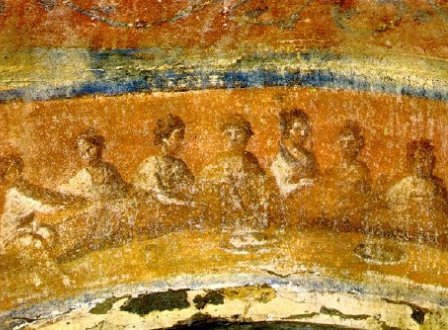
The Holy Sacrifice of the Mass in the catacombs
The Persecuted Church
Blessed Sister Zdenka Schelingová of the Sisters of Charity of the Holy Cross,27 born in 1916 in Kriva (Czechoslovakia), is an example of a countless host of martyrs who have offered their lives out of love for Christ and His Church.28
Sr. Zdenka had an extraordinary inner balance, and from her eyes shone something incredibly mysterious. Her own tender, modest smile became her leitmotif, so that she began her diary with the words: With a smile pluck the little roses of suffering, with a smile speak, with a smile help, with a smile accept injustices … With a smile hide everything that hurts you … With a smile walk on to Golgotha. There you will find Him who knew every malice, every falsehood, every human error long before you.
How deeply her life was anchored in the sacrifice of Jesus is shown also by the following words: Behind the dark clouds my beloved sun shines … From the altar of the Lord I go to the altar of my work, to breakfast and then to the infirmary. Everywhere I must continue the sacrifice of the altar – without fear and with joy.
With the aim of destroying the Church, the Communists from 1950 dissolved all monasteries and seminaries. On February 20, 1952 it happened: in the hospital where Sr. Zdenka worked, an alarm was raised. During the previous night a patient, the priest Štefan Koštial, who had been severely mistreated by torture, had escaped. The police even occupied the chapel in which the sisters were just at Holy Mass, and Sr. Zdenka thought: Now the time has come – now I too will go, for it was she who had helped the priest to escape. But at first the inconspicuous sister was not suspected. Only nine days later was she actually arrested. A second escape of three further priests and three seminarians, which she had prepared for that day, had been discovered. In prison four months of cruel interrogations followed. Sr. Zdenka was repeatedly brutally tortured and afterwards dragged back to her cell, covered with wounds.
Once, when she was nearly beaten to death, she whispered to a fellow prisoner: Forgiveness is the greatest thing in life.
When the judicial authorities saw that Sr. Zdenka was mortally ill as a result of the brutal tortures and of three and a half years in five prisons, they decided to release the religious sister conditionally on April 16, 1955. The government did not want at any price that she be seen as a martyr.
Sr. Zdenka spent the last three months in the cancer ward. She prayed much and radiated deep peace despite great pain.
In the night from Saturday to Sunday, July 31, 1955, the condition of the sick woman worsened, and because she felt that her life was coming to an end, she asked early in the morning for Holy Communion. Calmly and quietly Sr. Zdenka died at the age of 38, while in the chapel the Holy Sacrifice of the Mass was being celebrated.29
27 Great-aunt of Fr. Dr. Bernhard Vošicky OCist (Heiligenkreuz).
28 The martyrs are the sign that God lives and is always present among us. His merciful love reveals itself in Jesus Christ, who has promised not to turn away from His Church and from those who have decided to follow Him faithfully: “I am with you always, to the close of the age.” (Mt 28,20) Now, His presence is tangible in His persecuted disciples: “Saul, Saul, why do you persecute Me?” He answered, “Who are You, Lord?” And He said, “I am Jesus whom you are persecuting.” (Acts 9,4-5) (From God or Nothing by Cardinal Robert Sarah)
29 Cf. Triumph des Herzens No. 78.
Holy Archangel Michael, who in heaven defended the throne of the Most High against Lucifer’s attack, shield on earth the Vicar of God, the Pope, and the Catholic Church. Amen.
The Conversion of an Actor
Among the examples of genuine conversions that took place through the work of St. Pio (1887 – 1968) in San Giovanni Rotondo, the conversion of the actor Carlo Campanini stands out in particular. […]
Campanini’s path to conversion had not been easy. He was born into a poor family, but had a very pious mother. Carlo reports: If I have ever done anything good, it was only because she prayed from up there for this unhappy son. Who knows what would have become of me without her prayers. […]
The “spark from Padre Pio” ignited in him, as he says, when he was 19. At that time he worked in Argentina for a theater group from Piedmont. One day he said to his friend: To believe in God was simple when one could still meet great saints such as Francis of Assisi. But today, unfortunately, there are no great saints left.
His conversation partner answered: Well, there are still saints. We have one in Italy: his name is Padre Pio. A Capuchin friar who bears the wounds of Christ and offers up his suffering for the world. These words deeply impressed Carlo.
Campanini’s meeting with the Padre took place a few years later. He himself told in the prayer groups of Padre Pio: I had gone off the rails, because unfortunately I could accept only eight of the ten commandments of our Lord; the other two bothered me, and therefore I had rejected them all and lived like an animal. […]
At the end of 1949 I had reached the height of my fame, I was shooting three films at once, everyone envied me and said to me: You have it good, among all the beautiful women, with their expensive cars … I can only say how I felt. I hated my life.
On January 10, 1950 I got into the car and drove to Padre Pio. I signed up for confession and waited. My turn came. As I wanted to open my mouth, Padre Pio said to me: Tell me everything from 1946. You can imagine how I felt.
But as I spoke, I looked down at the floor. He said to me: Look at me! Look into my face. But I simply could not. Then the Padre said: You are ashamed before me, who am nothing, but Him you have offended without thinking about it. […] He wanted to hear everything. And only when I promised him to change my whole life did he give me absolution. From that day on I have really begun to live.
Despise your temptations and do not dwell on them. Picture Jesus, the Crucified, in your arms and on your heart, kiss the wound in His side and say: Here is my hope, here is the living fountain of my happiness. I hold You fast, my Jesus, and I will not leave You until You have brought me to safety. St. Pio
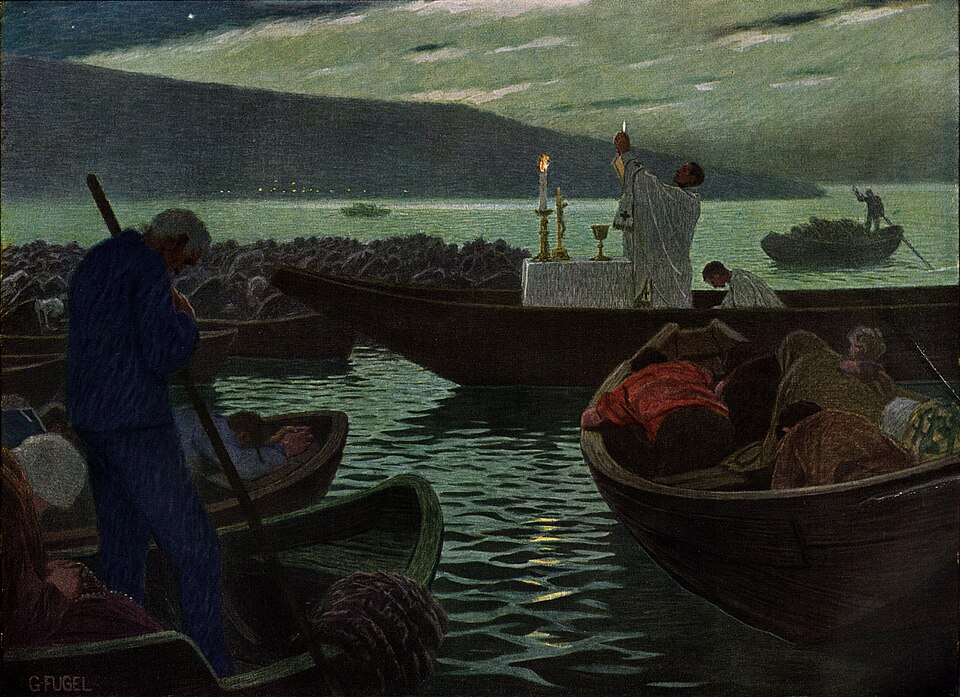
The Night Mass of the Persecuted (Gebhard Fugel, around 1920)
The Holy Mass
During his stay in San Giovanni Rotondo the Padre not only led Carlo back into the grace of God, but also guided him in the first steps of his new life. As the foundation he laid the Holy Eucharist.
Campanini openly admits that he had understood neither the value of the Holy Mass nor that of Holy Communion, and like so many others thought that one could be a good Christian even without going to Holy Mass.
When he observed the Padre at the altar, how he looked at the consecrated host, he asked himself: What are these tears and this blood that drip from his hands? Why does he suffer so? Why does he bear such a painful witness before the eyes of people day after day?
The actor tells: One day, while I was asking myself these questions, I clearly heard a voice in my heart say: Look also at that crucifix. […] How often have you leaned on that crown of thorns, in order to press it still deeper into His flesh; how often have you also struck with the hammer those wounded hands and feet?
I began to weep and would most gladly have made a general confession before all the people in the church. I felt a pain such as I had never known before in my life. And at the same time I became aware that I had received no new message: those words reminded me that I had been told already as a child in catechism that Jesus died for us and that His sacrifice is renewed in the Holy Mass. And I was yet to receive a sign.
On the morning before my departure I went to the altar to receive Holy Communion. When the Padre gave me the host, I felt that it burned on my tongue, as if he had placed a torch on it.
In the manner of receiving Holy Communion, that loving reverence and that delicacy should be reflected with which the Church surrounds her divine Bridegroom in the inconspicuous forms of bread and wine. From the Constitutions of the Capuchin Sisters of Perpetual Adoration in Salzburg
I hid myself behind the church in order to conceal my tears of joy and emotion. I truly felt the presence of God. On that day I promised Jesus, in thanks for His having let me grasp the gift of the Holy Eucharist, that I would go to Holy Mass daily and receive Communion.
When I was back in Rome, I was told that I was exaggerating and was about to become a fanatic, because even the Church demands only one reception of Communion a year and Holy Mass on Sunday. But I remained faithful to my promise.30
The Love of Suffering
Padre Pio taught Campanini much, but what impressed him most, and what he considers the most important lesson, is the love of suffering. One day the Padre said to him in confession: My son, if mankind could grasp the value of sufferings, people would no longer strive after joys, but only after pains.
Carlo admits that he was horrified by these words of the saint; he could not understand them. But as in the course of time he became more and more familiar with the Padre, he made this teaching his own. He said: I saw the Padre’s unspeakable suffering and saw that he offered it joyfully for the salvation of our souls. Then I too gradually began to understand that, despite my wretchedness, through my suffering I could offer something to the Lord of the universe.31
30 Hundreds of thousands have attended Padre Pio’s celebration of Mass in San Giovanni Rotondo in deep emotion, have seen his weeping, his bleeding stigmata, and have felt something of the immense drama that takes place in the renewal of the sacrifice of Golgotha.
31 “Der Padre,” Volume 1, by Fr. Marcellino Iasenza Niro, 2006.
Daily Offering
Eternal Father, through the most pure hands of Mary, I place into the chalice that every priest today lifts up on the altar my thoughts, my work, my efforts and sufferings, my presence, my past, my future, all my sins, all my loved ones, all the souls in the world, the Poor Souls, death itself.
I offer You every beat of my heart, every breath, every step, every sound, with the intention that each of these my actions may be transformed by You into as many acts of love in atonement for the sins of the world. Grant that, united with Your Son Jesus Christ, my day may be a continual Mass, a constant sacrifice,32 an eternal communion, to make satisfaction to Your divine justice! Amen.33
32 Just as Jesus renews daily His whole-burnt offering in the Holy Mass, so also we may at the Holy Sacrifice of the Mass renew our self-giving appropriate to our state in life, which we offer to the Heavenly Father united with the sacrifice of Christ. Every praise, every petition and every offering is like a vessel with which we again and again draw new graces from the infinite riches of the Heart of God.
33 Imprimatur: December 28, 1970.
The Divine Star and the Nuptial Soul
Jesus, the Savior, He is my star.
To live for Him alone, oh, that I gladly will.
Not only from heaven does He shine upon me,
but deep in the heart, for ever and ever.
Once He was a little star in the holy womb,
hidden as man and yet GOD, almighty and great.
Determined from of old by the eternal decree,
the WORD OF GOD was to become a child.
The Holy Virgin, she bore Him;
MARY, her name, GOD has chosen her.
She loves me so and leads me to the star,
O His Mother, how I love her!
Must not the world pass away in amazement?
For it has seen the star of heaven on earth!
Walking full of love in divine favor,
to shine on the sheep in poverty and guilt.
On Golgotha above, I cannot grasp it:
my star grows pale in love on the cross.
Oh, now it is so dark and night in the world,
but after three days He lights up everything.
Now He dwells with the Father in the heavenly tent
and shines full of goodness on the whole world.
But He has promised that He will remain here too,
hidden in the tabernacle, there He shines for me.
I need only hurry quickly to the little church,
there He dwells full of love and waits for the child.
Adoring and amazed I kneel there,
until He asks me: “My little child, what do you wish from Me?”
“O Star, O Star, that the sheep may find their way to You!”
Hear what He answers me:
“Love and suffer and pray for this,
then I will lead them to the heavenly gate!”
I ask the star still: “O tell me,
what do I mean to You?”
So I hear Him say to me with joy:
“Child, maiden, bride of My heart, does it please you so?”
Now He wants to know whether I love Him too.
“O Star, You know everything, only You do I love!”
And if they offered me gold and money, indeed even lands,
I would only say, that is not true.
All belongs to the Star, yes, everything alone,
and marvel, O wonder, and this One is mine.
From the breath of His mouth worlds arise,
not one thought can escape Him.
If I am sometimes very anxious and heavy,
I want to trust Him more and more.
Only out of love He sends me suffering,
for He knows its value for eternity.
And if I met a human child so utterly lost,
I would at once ask him: “Have you then fallen among robbers?
Come quickly, let us run to the Star, He loves you too,
and soon you will be as happy as I.”
When then my life is over one day,
then my star will shine for me into the heavenly house.
My heart wants to burst with joy and happiness,
finally at home, quite enraptured.
The angels in heaven, they sing very loud:
“O see, O see, now comes the bride!”
He presses me lovingly to the divine Heart
and wipes from my eyes all tears and pain.
Now I live with the Star in blessedness
and celebrate my wedding with Him for eternity.
Thanks be to the LORD, who has looked upon me
as His little beloved bride.
And if I have grieved His Most Holy Heart,
I will weep only with remorse and pain.
Then He shines red for me with holy Blood
and washes me clean in purple glow.
Also to you, my soul, He is not far,
He waits full of love and cares for you so much!
My star has been looking at me since eternity,
do you believe He does not think of you too? Capuchin Sisters of Perpetual Adoration
Behold, I am coming soon, bringing My recompense, to repay every one for what he has done … I am the root and the offspring of David, the bright morning star. The Spirit and the Bride say: Come! … Surely I am coming soon. – Amen. Come, Lord Jesus! Rev 22,12-20
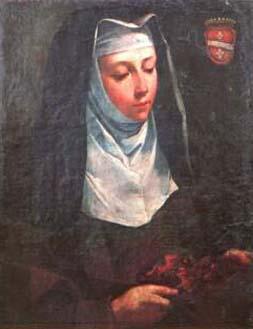
Blessed Angelina of Marsciano
Prayer for Vocations
Lord Jesus, once You called the first disciples in order to make them fishers of men, so let Your good invitation ring out constantly today: “Come and follow Me!” Give the young men and women the grace to answer Your call willingly! Stand by our bishops, the priests and the religious in their laborious pastoral work. Give perseverance to our seminarians and to all who seek to realize the ideal of total self-giving in Your service. Awaken in our communities the missionary spirit. Send, Lord, laborers into Your harvest, and do not allow mankind to lack the Gospel because of the lack of priests, missionaries and religious.
Mary, Mother of the Church, model of every vocation, help us to answer with “Yes” the Lord who calls us to cooperate in the divine plan of salvation. Amen. St. John Paul II
The Holy Mass is my heaven on earth! St. Lawrence of Brindisi
Blessed are those who are invited to the marriage supper of the Lamb. Rev 19,9