
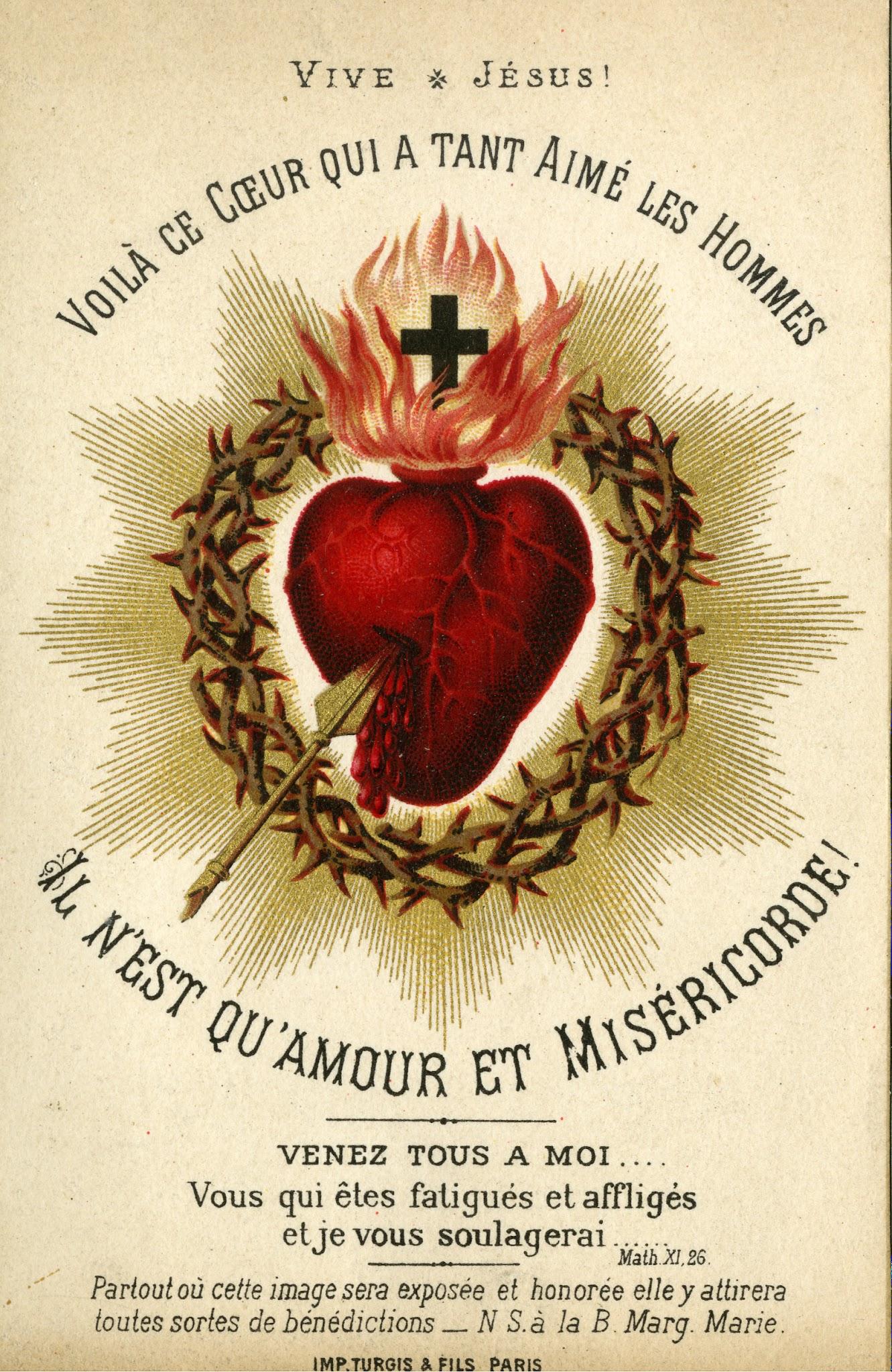
The Scapular of Our Lady of Mount Carmel
The Mantle of Mercy in Life and in Death
Devotion to the scapular lets a mighty stream of spiritual and temporal graces flow into the world. Pope Pius XII
This brochure of the Marian Movement of Priests and Laity presents the Brown Scapular of Our Lady of Mount Carmel: its biblical roots on Carmel, the great promise to St. Simon Stock, the Sabbatine Privilege, numerous graces bestowed, and the Church’s rite of blessing and investiture.
Contents
- Foreword
- The Mountain of the Mother of God
- A Prophet Like Fire
- The Little Cloud
- The Great Promise
- Longing for the Garment of Heaven
- Sharing in the Family Treasure
- How Can I Obtain the Promises?
- The Sabbatine Privilege
- In the School of Mary
- The Seat Belt of Heaven
- Remembering the Grace of the Scapular
- The Mantle of Mercy
- Bearers of the True Faith
- Graces Bestowed Through the Scapular
- Blessing and Investiture of the Brown Scapular
- Prayer to the Queen of Carmel
Foreword
Millions of Catholics wear the holy scapular of Our Lady of Mount Carmel upon their hearts with reverence and trust.
It is a special sign of consecration to the Immaculate Heart of Mary and a pledge of eternal salvation, as the Mother of God revealed it to St. Simon Stock. Mary knows very well into what dangers and afflictions her children are placed day after day. Therefore she offers them, for the protection of body and soul, this “little habit of heaven,” which is wholly steeped in the great treasures of grace of the Carmelite Order. With the words of Sacred Scripture she tenderly invites each of her children: Set me as a seal upon your heart! (Song 8,6)
Many people would gladly receive the holy scapular if they knew what extraordinary promises are connected with it. With this in mind, the Marian Movement of Priests and Laity has made it its task to spread and renew this devotion in the service of the Mother of God, for the blessing of many people.
I rejoice from my heart over this little brochure and wish all who will read it abundant graces from Our Lady of Mount Carmel.
+ Athanasius Schneider, Auxiliary Bishop of the Archdiocese of Saint Mary in Astana, on the Feast of Our Lady of Mount Carmel, July 16, 2025, in the Holy Year
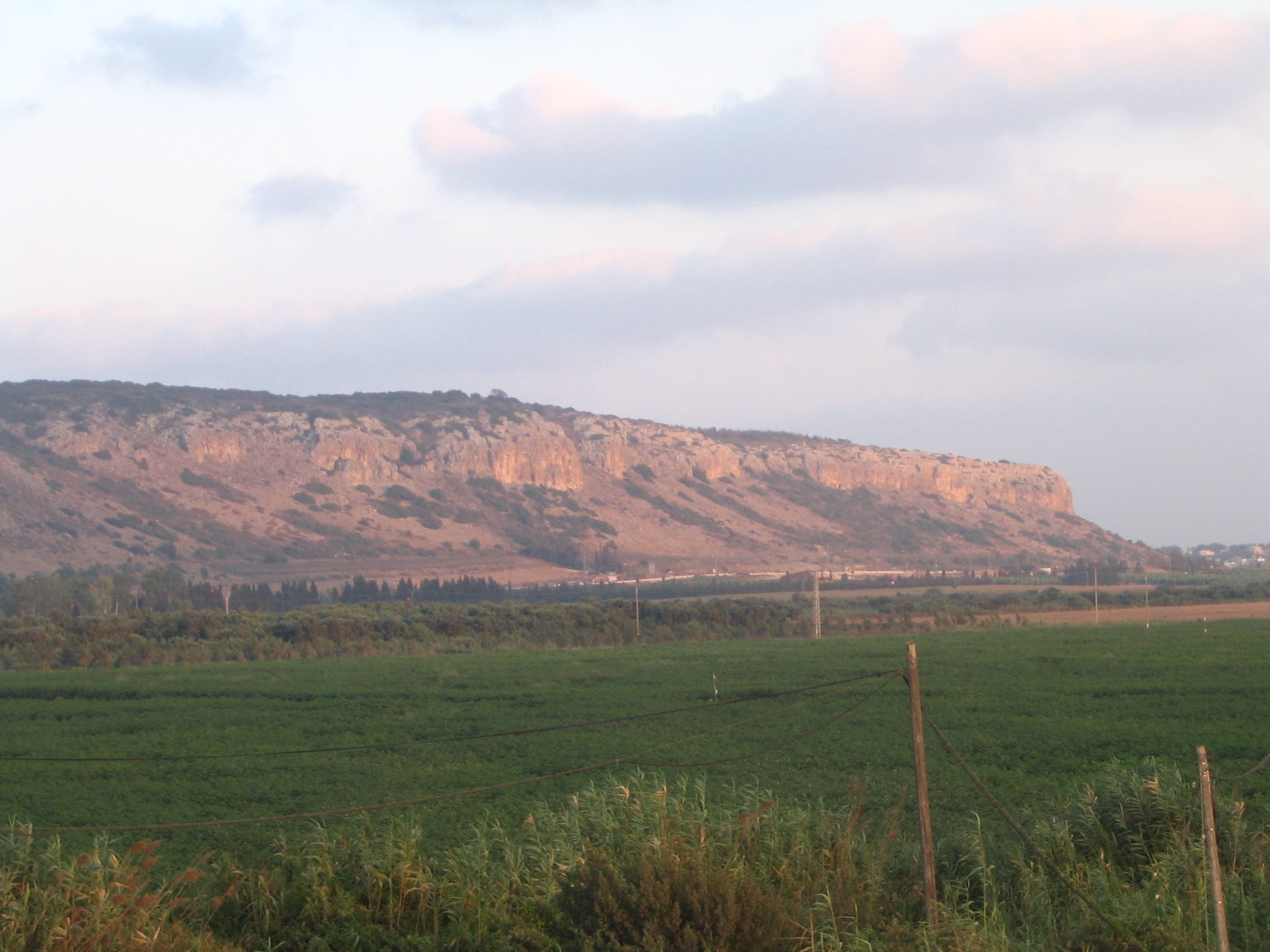
Mount Carmel
The Mountain of the Mother of God
Carmel is a holy mountain.
Already in Sacred Scripture the gracious beauty of the Carmel mountain range, which lies between the Mediterranean Sea and the Jezreel Valley, is praised. Your head crowns you like Carmel (Song 7,6), the Bridegroom declares in the Song of Songs, thereby extolling the beauty of his beloved.
It is indeed the case that Mount Carmel has become in the Bible a symbol of beauty and fruitfulness. The glory of Lebanon shall be given to it, the majesty of Carmel. (Is 35,2)
According to the interpretation of the Church Fathers, the beauty and holiness that are ascribed to Carmel as its typical qualities are united in the person of Mary, the Mother of God, who by reason of her place in the history of salvation is exalted above all creatures.
And this wonderful Mother and Queen of Carmel offers her children, who are so in need of help, the holy scapular as a sign of her special protection, in order to lead them safely to the mountain of eternal transfiguration.
You are all fair, my love; there is no flaw in you. Song 4,7
Set me as a seal upon your heart, as a seal upon your arm. Song 8,6
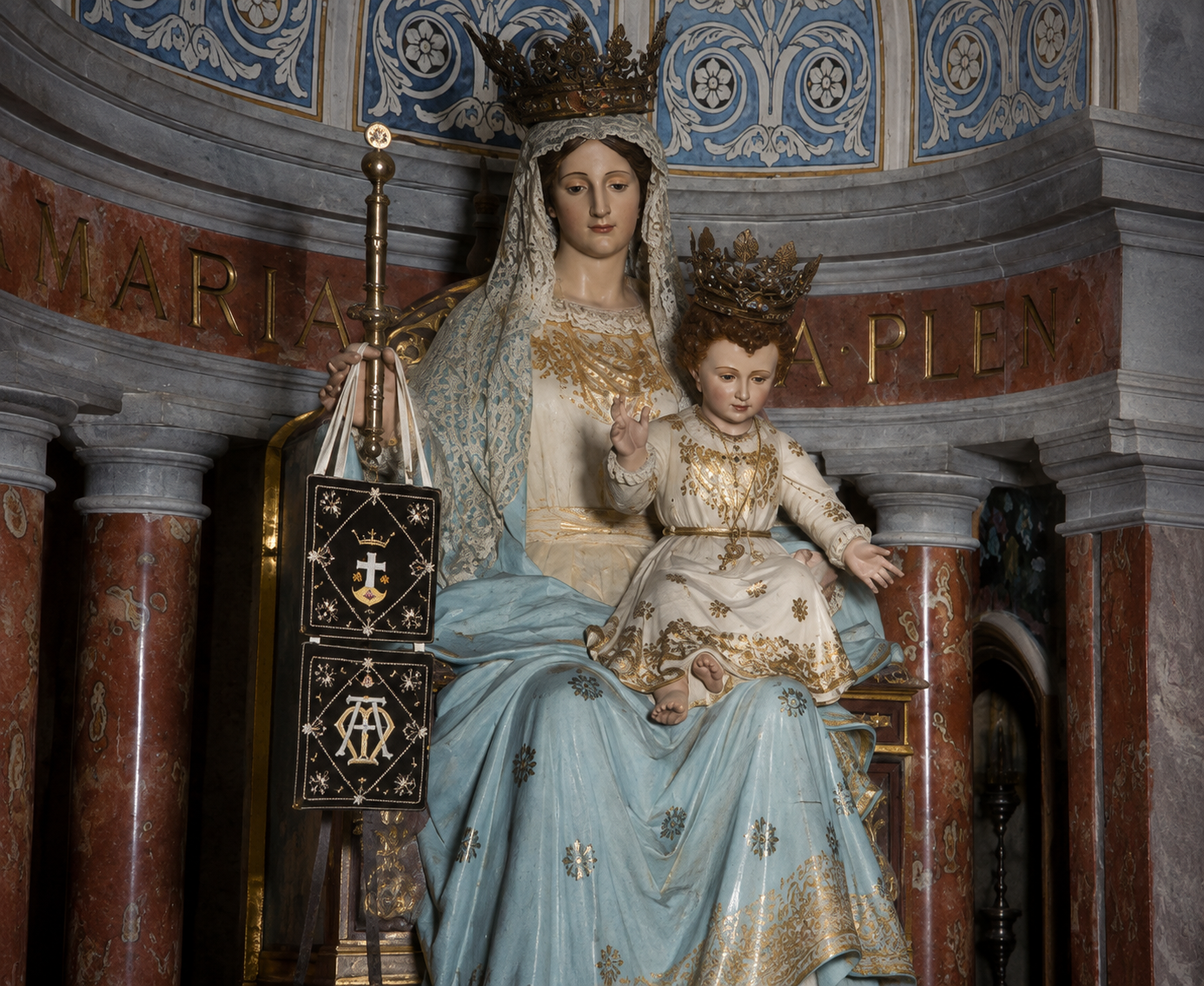
Statue of the Mother of God in the basilica on Mount Carmel
A Prophet Like Fire
Mount Carmel and its history are inseparably bound up with the mighty calling of the prophet Elijah, of whom the first volume of the Speculum Carmelitanum of 1680 says: Elijah, a most holy prophet, a high priest, the first monk and founder of monasticism; herald, venerator and imitator of the Mother of God; Christ’s future forerunner, apostle and martyr.
At the beginning of his mission stands the word of the Lord, who commands him: Depart from here and turn eastward, and hide yourself by the brook Cherith … (1 Kgs 17,2-3) Elijah first had to reap, in purifying solitude, with the sickle of prayer and penance, that seed which he was later to scatter, through his fiery preaching, into the hearts of the straying people.
Here a deep spiritual reality opens up to us: through every contact with God in prayer, and in the conscious union of our will with His divine Will, we reap heavenly seed, which bears abundant fruit not only in the field of our own soul but also in the field of the souls of all the people whom God has entrusted to us.
Depart from here and turn eastward, and hide yourself by the brook Cherith. You shall drink from the brook, and I have commanded the ravens to feed you there.1 1 Kgs 17,2-4
1 The “Depart from here” and the “hide yourself” are meant to point to the person who must detach himself from the transitory world in order, with the help of grace, to practice the virtues through which he attains purity of heart. The “turn eastward” calls us to battle against the natural concupiscence of the flesh, and the “hide yourself by the brook Cherith” means turning away from the bustle of men and freeing oneself from sin through the practice of love. Thus man can drink from the “brook” of his heart, by becoming able to taste the presence of God in his innermost being. For whoever – according to the word of Jesus – first seeks the kingdom of God (cf. Lk 12,31), God sends the ravens of bodily and spiritual benefactors, who provide him with the bread he needs for body and soul. Cf. Der Karmel im Heiligen Land, ed. by Silvano Giordano OCD, Wien 2025, p. 38.
To this very hour Elijah is a special model for all who lead a consecrated life in hiddenness, as well as for all priests and bishops who are called by God to strengthen and defend the Church through their fearless witness to the true Catholic faith.
Upon such a sacrifice of courageous profession divine favor rests, and it draws down abundant blessing from heaven.
In the following Elijah scene of the “judgment by fire” on Carmel, this is brought before our eyes in a moving way.
In the time of King Ahab of Israel (ca. 874 B.C.) great confusion reigned among the people through the mixing of different religions. This calamity was brought about above all by Jezebel, the willful and power-hungry wife of the king. She ran after the Baals and had the prophets of the Lord put to death, whereby faith in the LORD collapsed more and more. In this great distress God sent the prophet Elijah to lead the Israelites back to a genuine relationship with God and to fidelity to the covenant.
The Book of Sirach says of the prophet Elijah that he arose like a fire, (Sir 48,1) and his name indicates his mission, for Elijah means: “My God is truly the Lord.” At the word of the Lord he gathered all the people on Mount Carmel in order, in the exalted name of the LORD, to expose the false idols in their nothingness. Like the holy Archangel Michael, this courageous man of God raised his voice, crying out: How long will you go limping with two different opinions? If the LORD is God, follow him; but if Baal, then follow him. (1 Kgs 18,21)
The fearless prophet stood all alone before the 450 priests of Baal and proposed to them that an altar be built for the LORD and an altar for Baal. Then the LORD and Baal were to be called upon in turn. The God who answers by fire, he is God. (1 Kgs 18,24) From morning until noon the prophets of Baal now called upon their worthless idol and grew ever more frenzied, for there was no voice, and no one answered. (1 Kgs 18,26)
Then Elijah began to prepare the sacrificial altar for the LORD. After a short and essential invocation the fire of the LORD fell and consumed the burnt offering, the wood, the stones, and the dust, and licked up the water that was in the trench. (1 Kgs 18,38) Now the truth had prevailed, and those standing around were forced to admit the blindness of their hearts and the folly of their conduct. They fell on their faces and cried: The LORD, he is God; the LORD, he is God. (1 Kgs 18,39) The prophet had the priests of Baal brought down to the brook Kishon and put to death there.2
2 As Elijah, in the presence of King Ahab and the people of Israel, slew his adversaries, so also our Redeemer fought against the prince of this world and his followers and overcame them through His Passion and Cross. And He consecrates the altar of the Lord that had been torn down, that is, the hearts of the faithful, whom He cleanses from the filth of sin, into a place of sacrifice for God. (Albert Ohlmeyer, Elias Fürst der Propheten, Imprimatur: Freiburg im Breisgau, December 20, 1962)
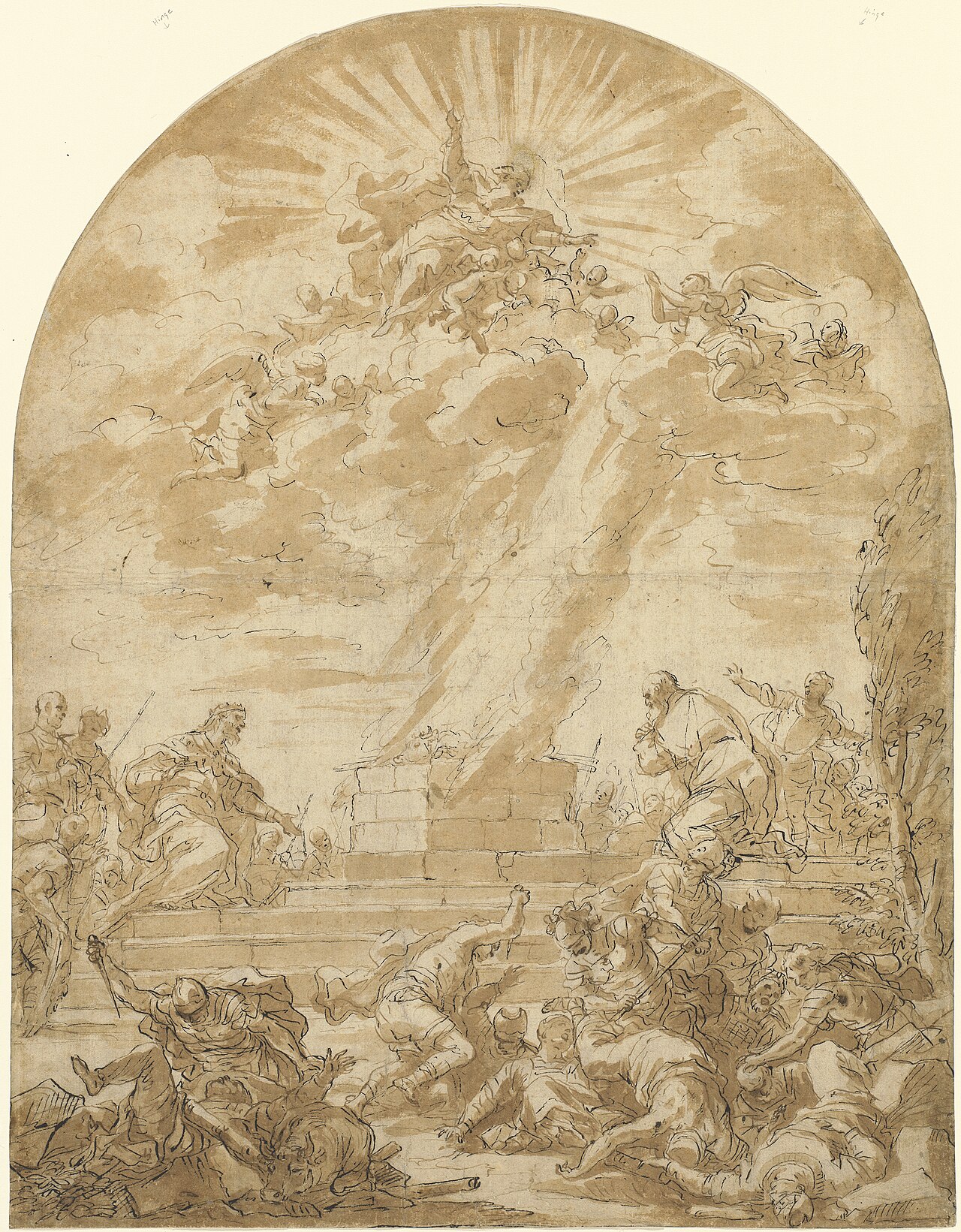
The God who answers by fire, he is God. 1 Kgs 18,24
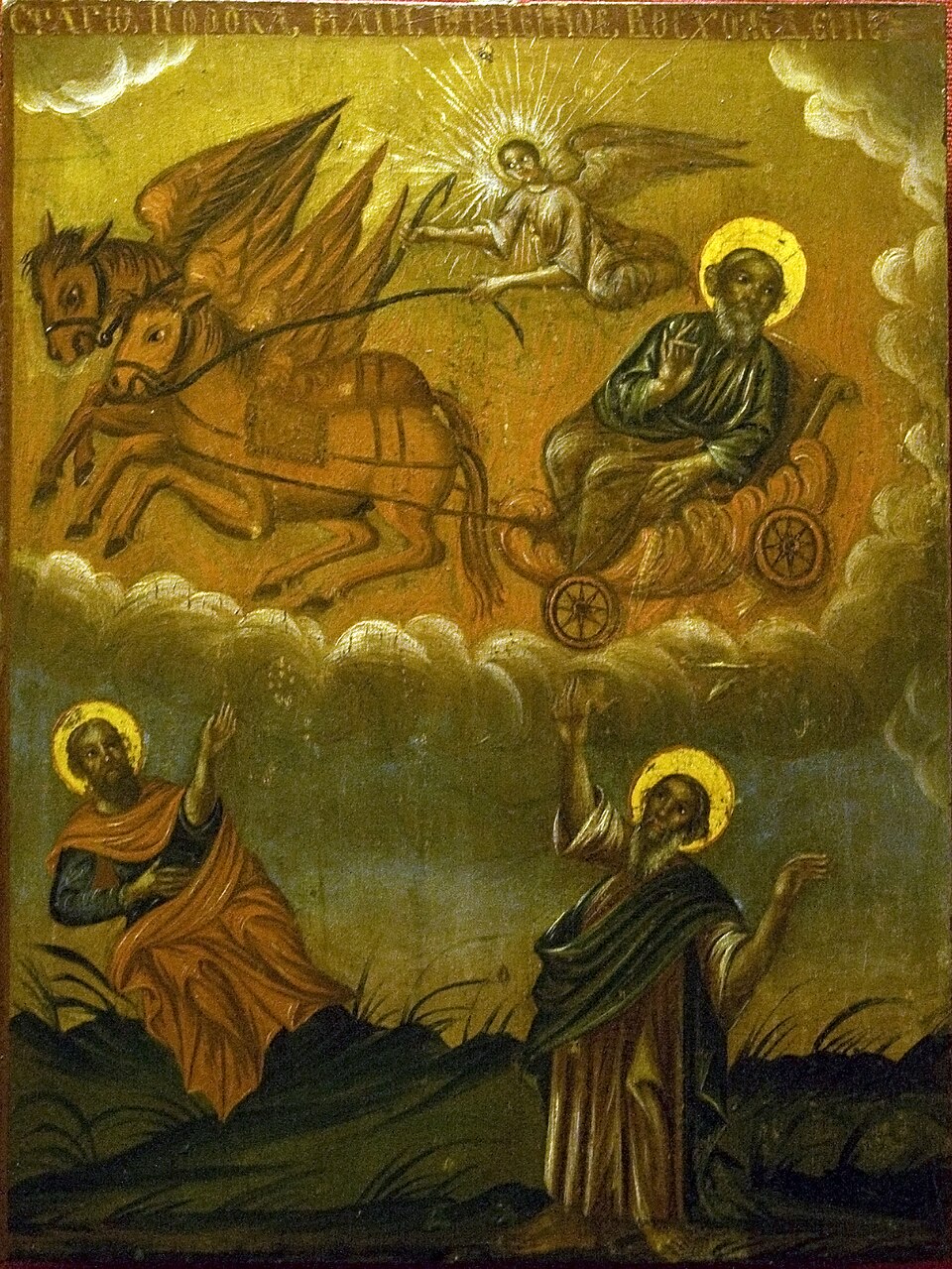
Elijah
The Little Cloud
On the heights of Carmel, Elijah, the prince of the prophets, had won a splendid victory. The men of Israel had once again bent the knee before the adorable majesty of God and, through the overwhelming miracle of fire, could be brought back to fidelity to their covenant God. Elijah, who was a saint and a man of faith, knew well that all strength came from God, and so his success only made him more humble.
Quiet and faithful to his mission, the man of God set out after the great contest with the prophets of Baal on the way to the summit of Mount Carmel. Absorbed in intercession and adoration, his head bowed between his knees, he implored his God for the longed-for rain. Finally he sent his servant out to look toward the horizon. And indeed, on the seventh attempt the servant saw a little cloud, as small as a man’s hand, rising over the sea.
This little cloud drew ever nearer and finally opened up over the parched land and gave it the redeeming rain.
The Carmelite tradition has always seen in this episode from the Elijah narrative (1 Kgs 18,36-41) a veiled announcement of the Virgin Mary.3
This prefiguration already contains all the elements of the Carmelite vocation: faithful and persevering prayer in silence, intercession for needy humanity, and the proclamation of the divine blessing. And at the heart of this vocation one finds the mysterious presence of the most pure Virgin Mary, the royal dispenser of all graces.4
3 In the vision of the cloud, Mary, as it were, takes possession of the height of Carmel as her mountain and consecrates the prophet as the first Carmelite, that is, as the true inhabitant of Mount Carmel, who is bound to the law of this mountain, namely the Marian one, of veneration and imitation of Mary. Mary here already proves herself to be Queen of Carmel, who has the right to reign in her domain. (Das Kleid vom Himmel by Gert Josef Weisensee, Lauerz 2000)
4 Cf. Philippe de Jésus-Marie OCD, Das Geheimnis des Karmel, durch das Skapulier mit Maria leben, Wien 2021.
The Great Promise
In the 12th century hermits withdrew to Mount Carmel and founded the Carmelite Order in order to lead a life of contemplation under the protection of the Mother of God. On account of the severe persecutions and tribulations that broke over the Order, St. Simon Stock, who led the Carmelites as their 6th Prior General, implored the Mother of God unceasingly to take the Order under her care and to grant it a special pledge of her protection.
The testimonies confirmed by the Church report on this as follows:
Often (Simon Stock) besought the Mother of God, the glorious Virgin Mary, the patroness of the Order, to grant a privilege to the brothers who bear her name. Every day he said in his fervent prayers: Flower of Carmel, tall vine blossom-laden, splendor of heaven, childbearing yet maiden, none equals you. Mother most tender, whom no man did know, on Carmel’s children your favors bestow, Star of the Sea.
And one day, while he was devoutly saying this prayer, the Mother of God, the glorious Virgin Mary, appeared to him, accompanied by a great host of angels and with the scapular of the Order in her hands. And she said to him: Take, my beloved son, this scapular of your Order. It is the special sign of grace that I have obtained for you and for the children of Mount Carmel. Whoever dies clothed in this garment will not suffer eternal fire. It is a sign of salvation, a safeguard in dangers, a pledge of peace and of an everlasting covenant.5
In remembrance of this wonderful apparition of the Mother of God, which took place on July 16, 1251, the Church celebrates the Feast of Our Lady of Mount Carmel (the “Feast of the Scapular”) on this day.
5 Ibid. as well as Das Kleid vom Himmel.
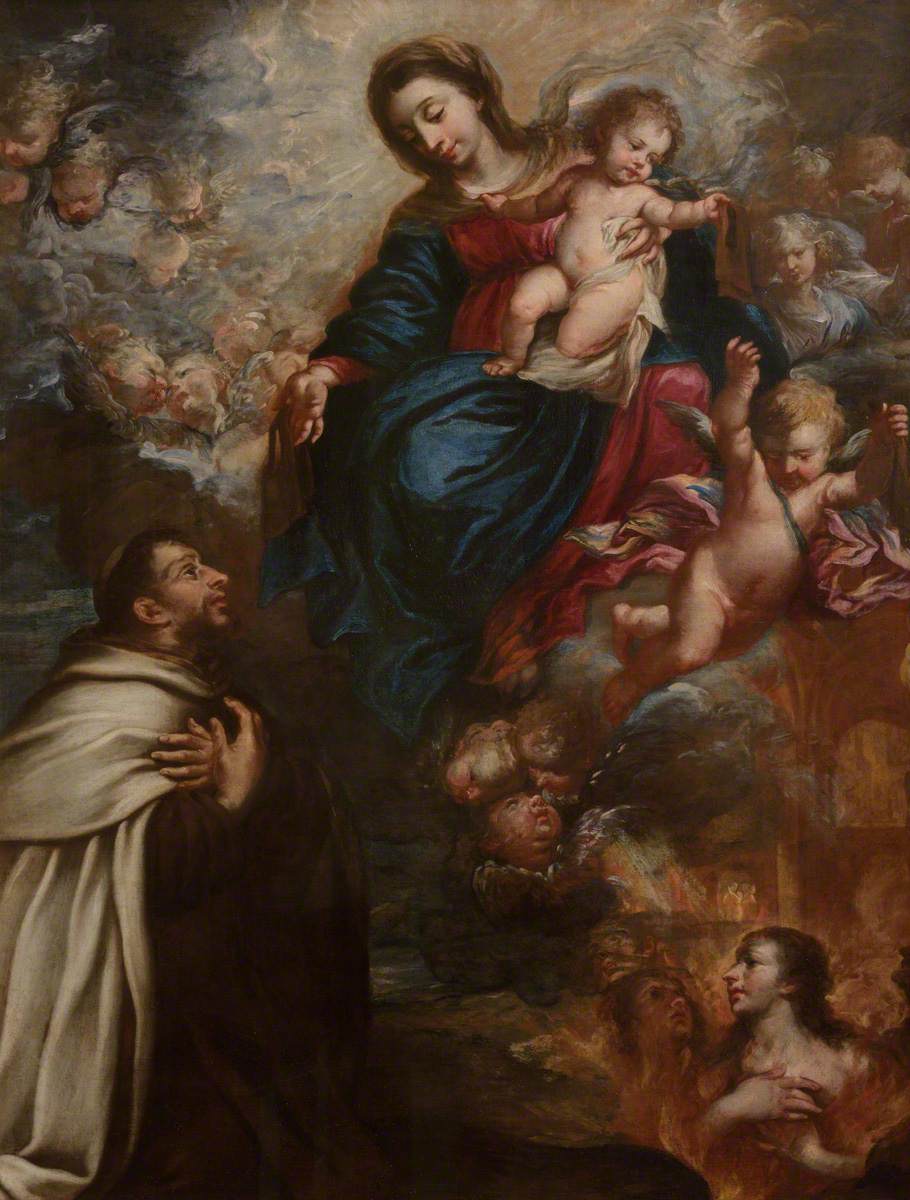
Mary hands the scapular to St. Simon Stock.
Longing for the Garment of Heaven
When this precious promise of the Mother of God became known, the faithful in the world also wanted to possess this priceless pledge of a good death. Popes and cardinals, emperors and kings, bishops and priests, and millions of the faithful have clothed themselves with this garment of Mary, in order to assure themselves of her special protection in life and in death and to share in the numerous graces and privileges.
St. Simon Stock established the Scapular Confraternity, confirmed by the Apostolic See, in honor of Our Lady of Mount Carmel, which was recommended by numerous popes and enriched with precious indulgences. Countless people have found deliverance through the holy scapular in illnesses, in fires, in danger of drowning, in mortal wounds, in dangers of seduction, and in many other needs, bodily as well as spiritual, as a multitude of examples in the history of the Confraternity attest.6
I too have worn the Scapular of Carmel over my heart for a long time!7 St. John Paul II
6 Das Schutzkleid Mariä by Father Thaddaeus Ballsieper O. Carm. Imprimatur: Bamberg 1958.
7 When Pope John Paul II was shot on May 13, 1981, he asked, before the operation to remove the bullet, that the doctors should not remove his scapular. (Kämpfer des Rosenkranzes by Donald H. Calloway MIC, Kißlegg 2024, Imprimatur: May 31, 2016)
Sharing in the Family Treasure
The scapular is the “miniature edition” of the habit of a Carmelite and thus also a sign of fraternity, since through it one is received into the family of Carmel. In this family one receives – together with the brothers and sisters with whom one is still journeying here on earth – a share in the spiritual treasure of all the saints of Carmel, whether they are canonized or not.
Likewise, with the investiture with the scapular one also becomes a member of the Scapular Confraternity and receives a share in the many prayers, good works and merits of the millions of Confraternity members throughout the world.
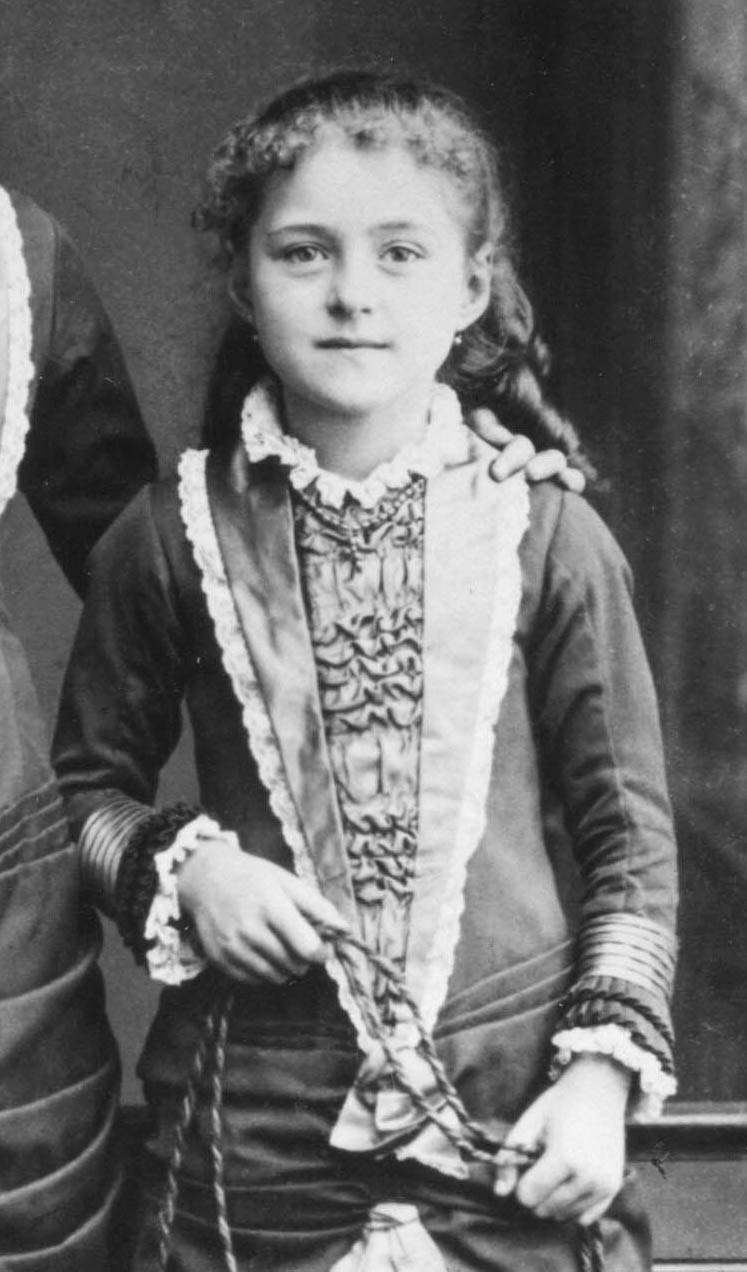
St. Thérèse of the Child Jesus as a child (1881, before her entry into the convent)
How happy I am that you are clothed with the holy scapular! This is a sure sign of predestination, and does it not also unite you more intimately with your little sisters in Carmel? From a letter of St. Thérèse of the Child Jesus to her friend Céline Maudelonde
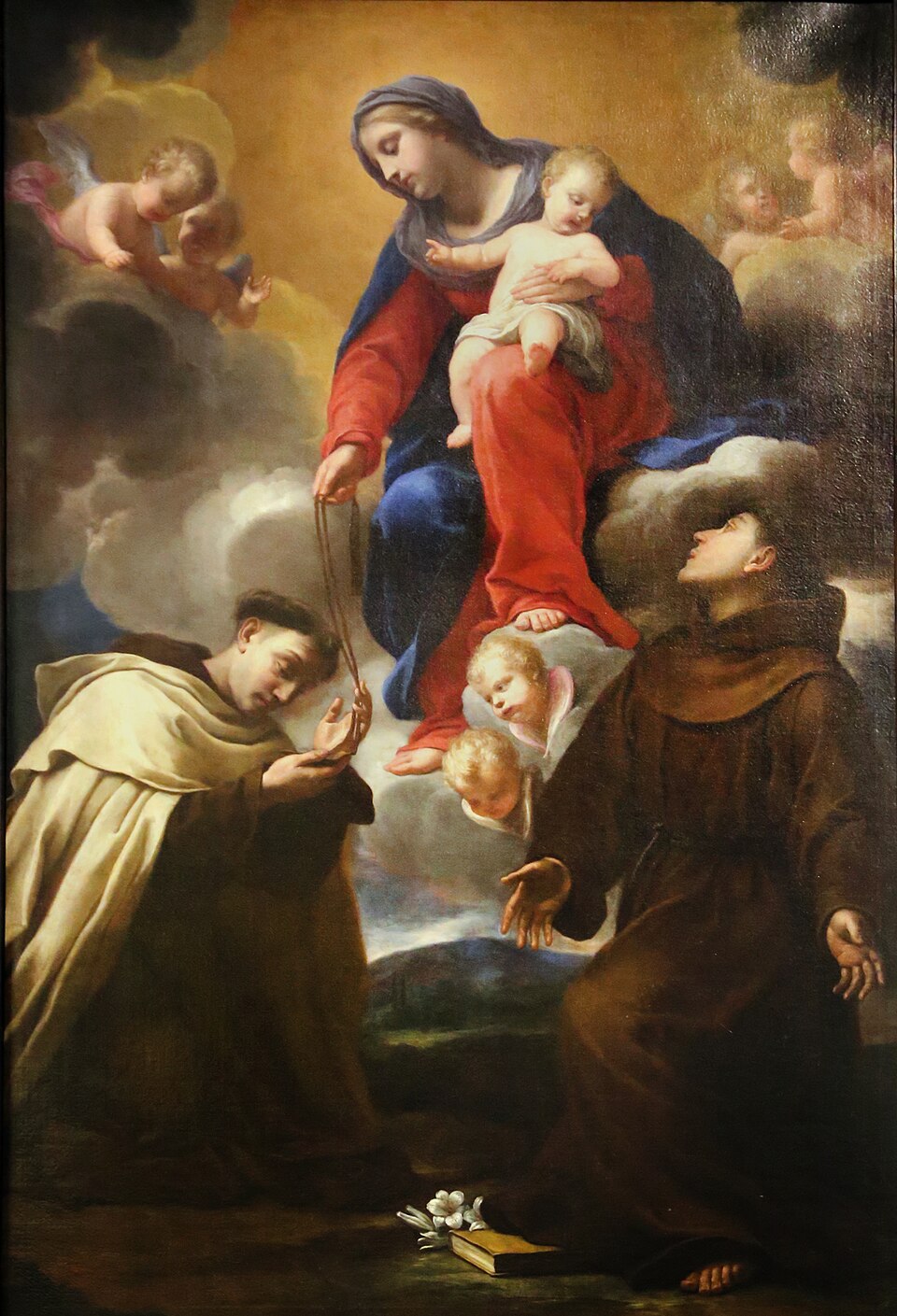
Glorification of Mary in heaven amid the saints of the Carmelite Order
How Can I Obtain the Promises?
In order to obtain the special promises that are attached to wearing the scapular, one must be invested with the blessed scapular by a priest and wear it day and night around the neck, so that one part lies on the chest and the other on the back.8
In preparation for receiving the Brown Scapular it is advisable to make a sincere confession and to form the firm resolution to venerate the Mother of God with heartfelt devotion, especially through praying the Rosary.
8 The scapular must consist of two square pieces of woolen cloth, which are joined at both ends by two cords or bands. If someone cannot wear the cloth scapular for good reason, there is the possibility of wearing a scapular medal that has been blessed accordingly. This was permitted by Pope Pius X in 1910 on account of the climatic conditions in the mission territories, which were in part difficult. However, it should be borne in mind that the Mother of God expressly spoke of the “garment” and that Pope Benedict XV attached an indulgence of 500 days to the kissing of the cloth scapular, in order to point scapular wearers to the importance of the cloth scapular. If the scapular has to be replaced, it does not need to be invested again by a priest.
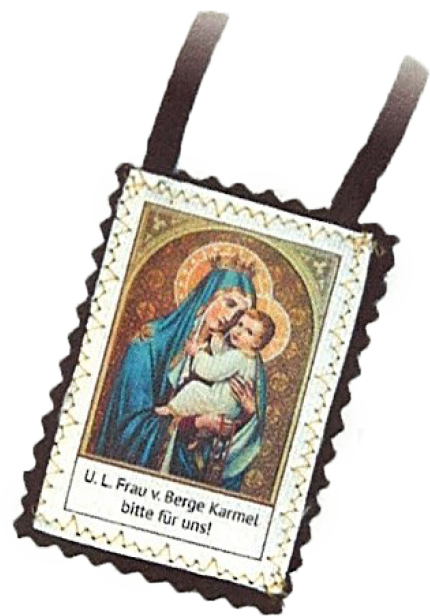
Brown Scapular
The Sabbatine Privilege
About 70 years after the promises of the Mother of God to St. Simon Stock, the Most Blessed Virgin Mary revealed to Pope John XXII the so-called Sabbatine Privilege, of which she spoke to him in an apparition: Whoever enters this Order and devotes himself with dedication to this way of life will be saved forever and freed from the pain of his guilt. And if they (the brothers of the Order) come to Purgatory on the day of their passing, I, the Mother of Grace, will descend there on the Saturday after their death and free those whom I find there and lead them to the holy mountain and to eternal life.
Pope John XXII published this grace by means of a bull, drawn up in his own hand, dated March 3, 1322, at Avignon. Because of the liberation assured for Saturday, this bull is called the “Sabbatine Bull,” and it was confirmed by several popes.
The Promise Reads
Those who die in the grace of God will be freed from Purgatory on the next Saturday after their death if, during life, they have worn the scapular, observed chastity befitting their state,9 prayed the Little Office of the Blessed Virgin Mary daily10 or instead abstained from meat on all Wednesdays and Saturdays.11
Mary, the gentlest Mother, will also not fail to lead her children who are expiating the punishments for their sins in Purgatory, upon her intercession with God, according to the so-called Sabbatine Privilege, as quickly as possible into their eternal home. Pope Pius XII
9 Chastity befitting one’s state is an essential component of Christian love, in that it preserves us from every possessive behavior toward our neighbor and rather leads us to meet him with all the respect that is due to him as a child of God. (Das Geheimnis des Karmel)
10 Today the Rosary is also counted among the prayers that can replace the Little Office of the Blessed Virgin Mary.
11 Tragt das Skapulier! by Paulus Deusdedit, Lauerz 1996-2004.
Mary intercedes with her Son for the members of her Order:
My Son, for the sake of this holy breast that nursed You, have mercy on my children and free them from their torments.
– Mother, let it be done as you have asked. Inscription on a Carmelite votive image (the image is reproduced in the printed brochure)
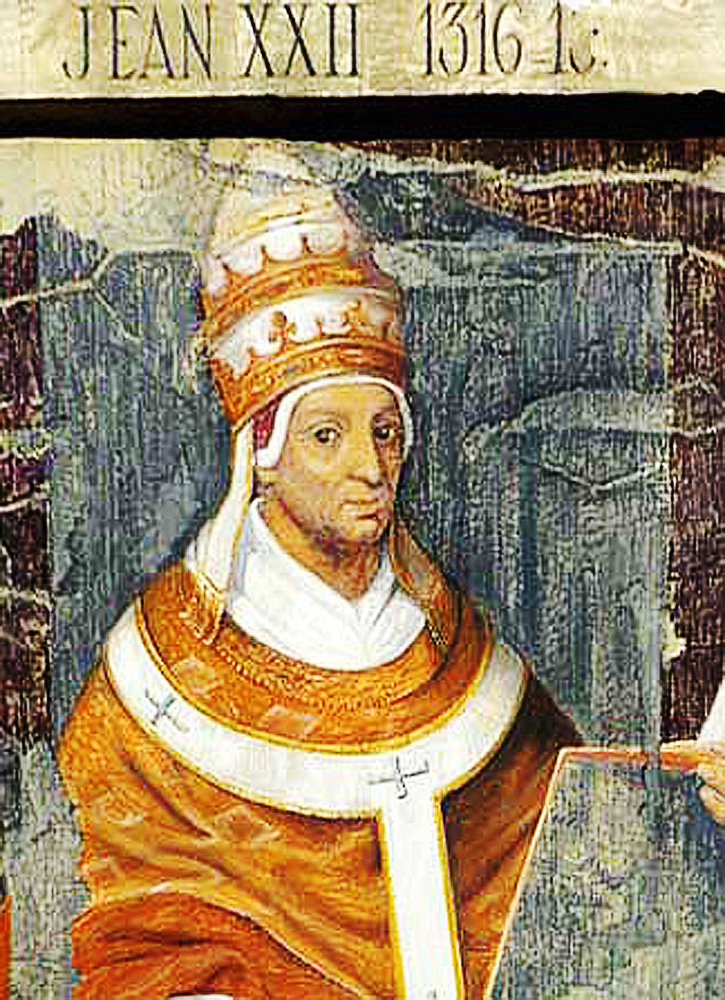
Pope John XXII
In the School of Mary
Nothing is small when one, like the Virgin Mary, lives with His heart in the presence of God and listens to His holy will for our life. Every event, every encounter bears fruit for eternity. St. Francis de Sales loved to say that every moment conveys to us a command of God and returns to eternity with what we have made of it.
On our poor human paths we can accomplish, for ourselves and for others, things that have eternal value. What is eternal in us is what comes from God – the life of God, the life of the children of God, which is poured into our hearts through the Holy Spirit. And so Mary teaches us, when she places the scapular upon us, that genuine love must always express itself in the small actions of everyday life: a smile, a small sacrifice or an inconvenience borne out of love for God, an act of patience, of humility … There are so many ways to speak our “yes,” our “Fiat,” in answer to God’s call.
In his book The Secret of Mary, St. Louis Mary Grignion de Montfort writes: One must do all one’s actions for Mary (…) and often repeat in the depths of the heart: ‘O my dear Lady, it is for you that I go here or there, that I do this or that, that I bear this or that adversity or offense!’
And in the Counsels and Reminiscences of St. Thérèse of the Child Jesus, her sister Céline tells us how deeply Thérèse had entered into the spirit and the intentions of Mary: One afternoon, at three o’clock, I noticed that she was praying, and I asked what she was saying: I am saying a Hail Mary to offer my work to the Blessed Virgin. I have gotten into the habit of acting this way every time I begin a task.12
12 Das Geheimnis des Karmel.
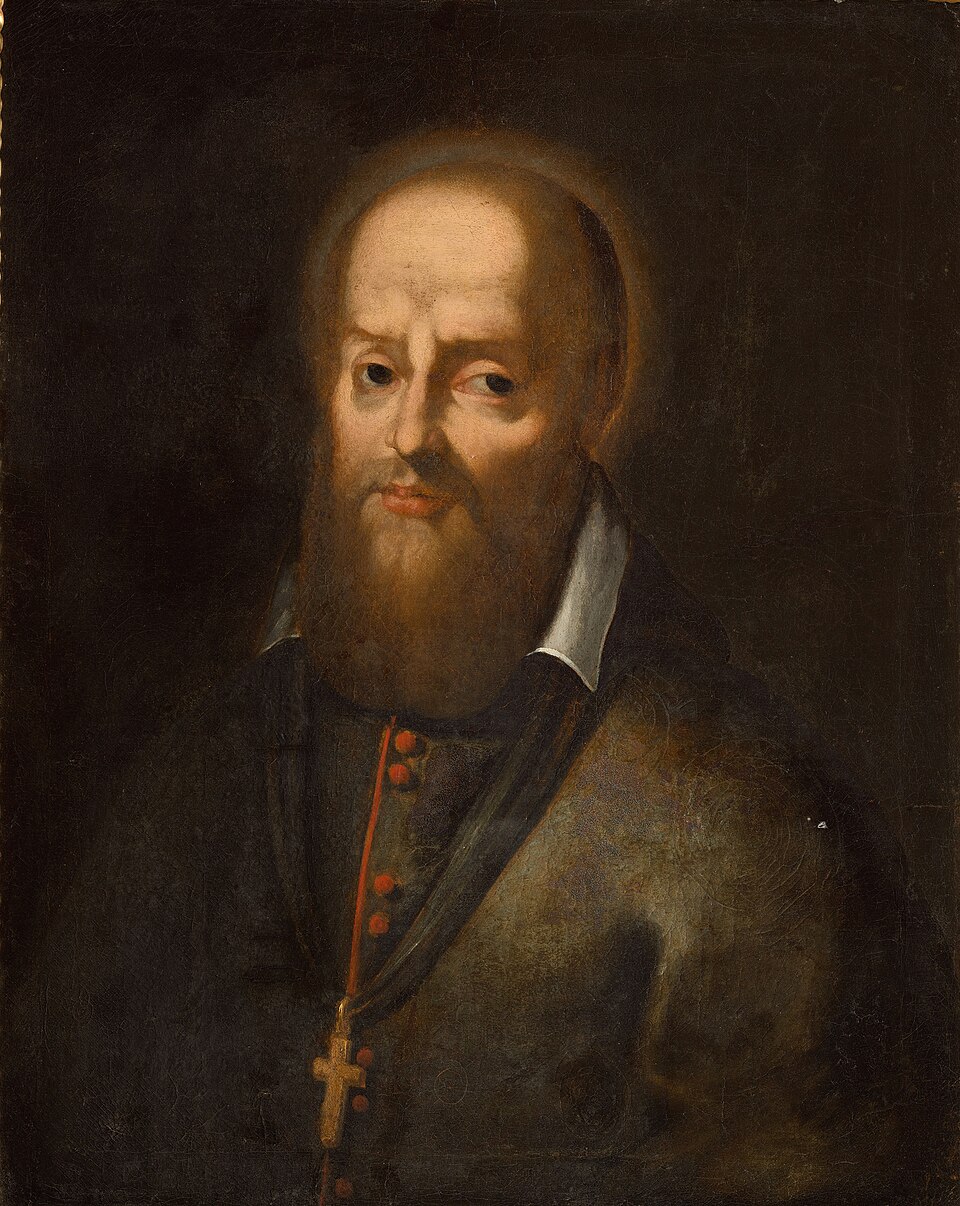
St. Francis de Sales
The Seat Belt of Heaven
The Immaculate Heart of Mary beats with every fiber for God and for the salvation of the children of men. Therefore the Most Blessed Virgin Mary wants to bring us to safety from our three worst enemies – the world, the devil and our own concupiscence. Yes, she wants to bind us, as it were with a “heavenly seat belt,” firmly to her maternal heart, so that we do not fall on the perilous journey into eternity.
In his clear language, which is wholly imbued with zeal for the honor of the Immaculata, St. Maximilian M. Kolbe declares: The scapular, the Rosary and the Miraculous Medal: these are three things that the Immaculata herself offered for the salvation of mankind.
For this reason Mary, in her messages, again and again turns our gaze to our salvation and the last things, about which so little is preached today: death, judgment, Purgatory, hell and paradise.
And yet it is precisely these realities to which the scapular wants to lead us back. How is one to lead a deep, authentic Christian life if one forgets the meaning and the goal of human existence with its dimension of eternity? We are called to choose life, that is, to decide for God. But we can also reject this free gift and close ourselves to the infinite mercy of God.
Mary’s task is to help us, in the decisive hour of death, to turn trustfully to our Father and – after the example of the good thief – to ask Him for grace. And beyond that she asks God that we convert already today!13
13 Cf. ibid.
Remembering the Grace of the Scapular
Since heaven knows of our human forgetfulness, Providence has ordained that the two great Marian apparitions of the 19th and 20th centuries – Lourdes and Fatima – each came to its conclusion under the sign of the scapular.
Indeed, it was on July 16, 1858, the feast of Our Lady of Mount Carmel, that Mary appeared for the last time at the grotto of Massabielle. On that day, as Bernadette reports to us, the Virgin remained silent, yet at the same time showed herself more beautiful than ever. Mary, the Queen and Ornament of Carmel, crowns the series of eighteen apparitions with the remembrance of her presence in the Carmelite Order.
In quite a similar way Mary also wished to show herself to the shepherd children at Fatima – when she appeared to them for the last time on October 13, 1917 – as Our Lady of Mount Carmel, clothed with the scapular.
Interview with Sr. Lúcia
It is instructive to read the interview with Sr. Lúcia that was granted in 1950 to Father Howard Rafferty:
Father Howard: In many books about Fatima the authors do not admit that the scapular is an integral part of the apparitions.
Lúcia: Ah, they are wrong!
Fr. Howard now asks what significance is to be attached to the apparition of Our Lady when the Virgin holds the scapular in her hands.
Lúcia: She wanted thereby to make it understood that she wished everyone to wear the scapular. She added: The Holy Father said it to the whole world, explaining that the scapular is the sign of consecration to the Immaculate Heart of Mary. No one can exempt himself from it today.14
Father Howard now asks Sr. Lúcia whether the scapular is indispensable in order to fulfill the wishes of Our Lady of Fatima.
Lúcia: Yes!
Father Howard: Would you say that it is just as indispensable as the Rosary?
Lúcia: The Rosary and the scapular are inseparable!15
14 Allocution of Pius XII on the occasion of the 700th anniversary of the scapular.
15 Tragt das Skapulier!
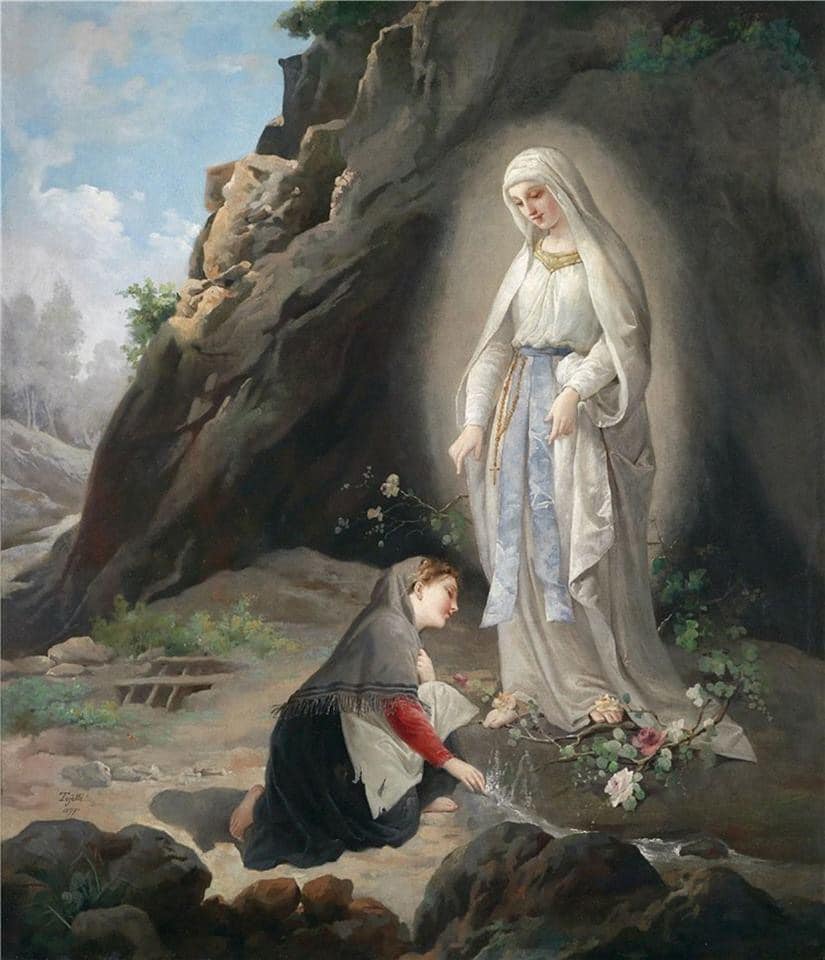
Our Lady of Lourdes / St. Bernadette
The Mantle of Mercy
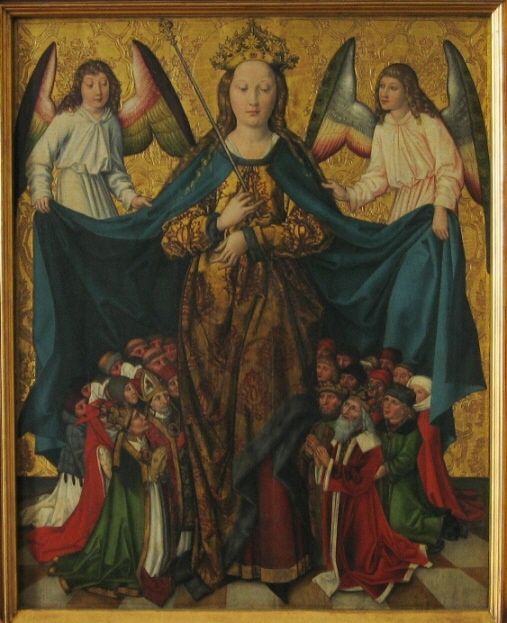
With the help of the scapular, with which we, as it were, put on Jesus and Mary, we place ourselves in the stream of love that unites these two most holy Hearts. Thus we are introduced into intimacy with the triune God, so that in the heart of the Church, our Mother, we may be love, and our little life may lend new grace and strength to her mystical Body.
But what does it mean for us concretely to “put on” Jesus and Mary? It means entering into their life, making their feeling, willing and acting, their love and mercy our own. We must therefore clothe our heart with the mind of Jesus and Mary and divest ourselves of the rags of our past sins and disordered passions. Likewise we must let fall all our masks, all hypocritical and mendacious disguises, so as to wear only the garment of the truth of Christ. And when, in our human weakness, we stumble and fall again and again, the scapular can become for us a true “mantle of mercy.”16
The Virgin Mary presses her broken children to her Immaculate Heart and reconciles them with her divine Son.17 But we ourselves, too, are to let this merciful love, which we may receive anew each day, flow on to all the people whom God has entrusted to us, especially to those who are most in need of His mercy. And when we press the scapular to our heart and kiss the image of Mary again and again, we can also do this vicariously for others, in order thereby to wrap them in the mantle of mercy, by clothing them spiritually with the scapular.
16 Cf. Das Geheimnis des Karmel, p. 113.
17 Following the sacrament of Penance, the scapular can be understood as a firm resolution of fidelity: it stands for the new garment, the new habits, with which one wishes to clothe oneself from now on. The mere presence of this piece of cloth will recall this desire to one, and it will be a constant invitation to trust in Mary’s intercession.
O Mary, I am yours for time and eternity.
Through you and with you I now wish to belong wholly to Jesus forever.
Amen.
Mantle of Mercy
Bearers of the True Faith
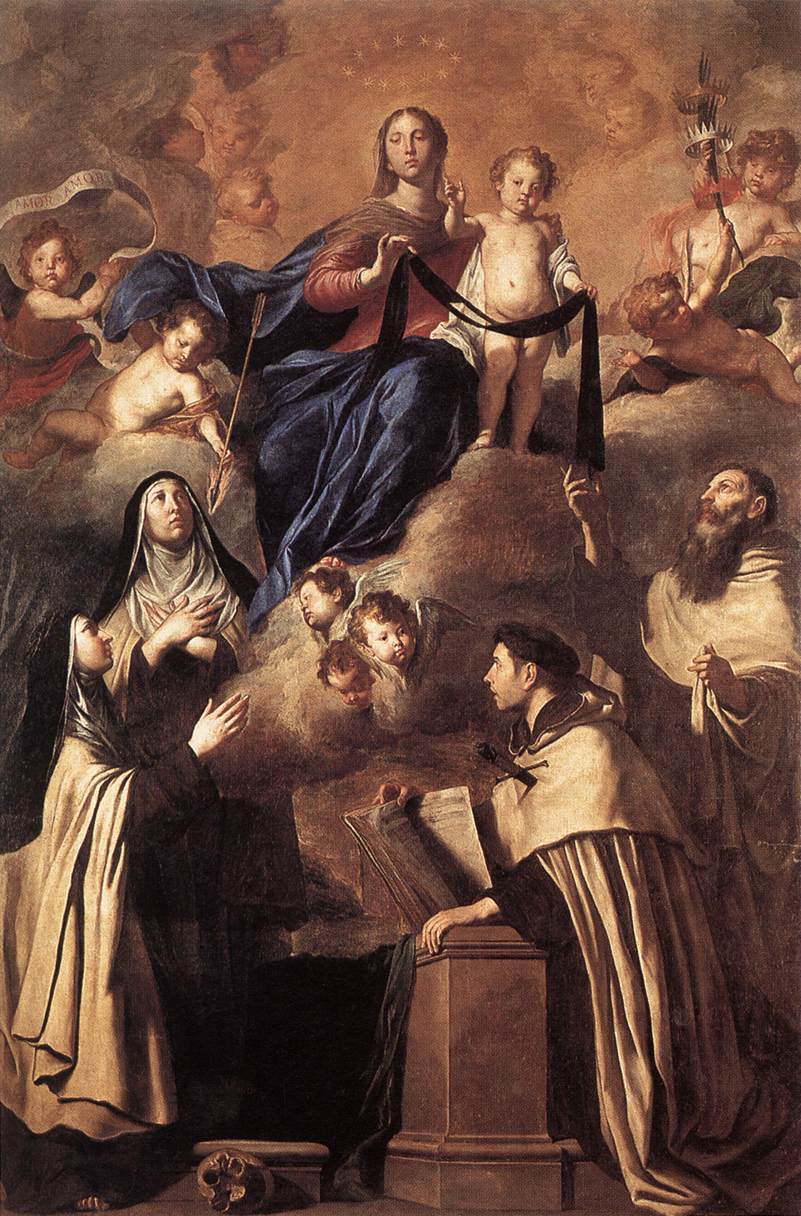
To wear the scapular upon our heart also means to be, courageously and steadfastly, bearers of the true Catholic faith. This childlike and loving obedience of faith, which touches the Father’s heart and protects us against the attacks of the devil, is imparted to us by the Mother of God when we boldly take our place in her battle ranks.
Let us think here once more of the prophet Elijah, who stood up on Mount Carmel, very zealous for the LORD, the God of hosts (1 Kgs 19,10-14). In our Church we are experiencing right now a dramatic situation similar to that in the time of Elijah. It is the struggle between the true Church and the anti-Church, between the true God and the false idols, which is coming to an ever sharper head. Hidden behind the mask of liberalism, modernism, relativism, naturalism etc., Lucifer has succeeded in walking as a wolf in sheep’s clothing right through the Church, to sow confusion and to persecute lay people, priests, bishops and religious communities who remain faithful to the faith and do not bend the knee before the new “Baal gods.” (Cf. 2 Kgs 18,3-4)
Mary of Mount Carmel
If we now ask ourselves, where is the true Church and how can we remain faithful to the true Church?, Jesus Himself gives us the one right answer: Behold, your mother! (Jn 19,27) Mary is the mother of the reviled and persecuted Church, which she carries in her Immaculate Heart, where it can never perish. If we consecrate ourselves to the Mother of God and follow her maternal directions, then we live through her in the very heart of the true Church and cannot go astray.
Yes, after all sufferings and persecutions we will celebrate with her, the vanquisher of all heresies,18 the triumph that she promised us at Fatima: In the end my Immaculate Heart will triumph!
18 The root of all evil and of every heresy is spiritual pride, which distorts and darkens one’s view of the truth. A demon was compelled to confirm this fact through a possessed person over whom the well-known exorcist Francesco Bamonte was praying: The soul of that one there (the Mother of God) shines with her humility. If you were humble, you too would radiate light and everyone would see it. That is why I must bring you to be arrogant, so that everyone sees the black of hell instead of the light of paradise. Every time she convinces you to renounce something arrogant, she wins a battle. (Maria im Dienst des Exorzismus by Francesco Bamonte, Imprimatur: Mons. Luigi Moretti, Vicariato di Roma, January 20, 2010)
The Virgin without stain, vanquisher of all heresies, will not yield before the enemy who raises his head against her. If she finds faithful servants, obedient to her command, then she will win new victories, greater than we can even imagine. St. Maximilian M. Kolbe
Graces Bestowed Through the Scapular
From the history of the Scapular Confraternity, countless answered prayers and rescues have been handed down. The following events stand for many.
The Scapular on the Night of Death
When a Jesuit father was inspecting the dormitories of a boarding school one evening, he found a boy kneeling before his bed. Asked why he had not yet gone to bed, the little one replied: I gave my scapular to the porter to be sewn, and I have not yet received it back. I dare not go to sleep, for fear of dying without my scapular.
Do not be afraid, my friend, said the father, it will be given to you tomorrow, just go to bed and sleep peacefully. Father, I cannot go to sleep, I may die this very night. With that the child burst into tears.
Now the father went to the porter and brought the little one his scapular. Happy and reassured, the child kissed his precious treasure and fell asleep. The next morning the father saw that the boy had not yet gotten up. He called him, but received no answer. The good child had died in the night.
He had kissed his scapular until he fell asleep, and still held it pressed to his smiling lips.19
19 Tragt das Skapulier!
Virgin Mother of God, make me wholly your own.
Yours in life, yours in death, yours in misfortune, fear and need.
Yours in the cross and bitter suffering, yours for time and eternity.
A Fallen-Away Priest Converts
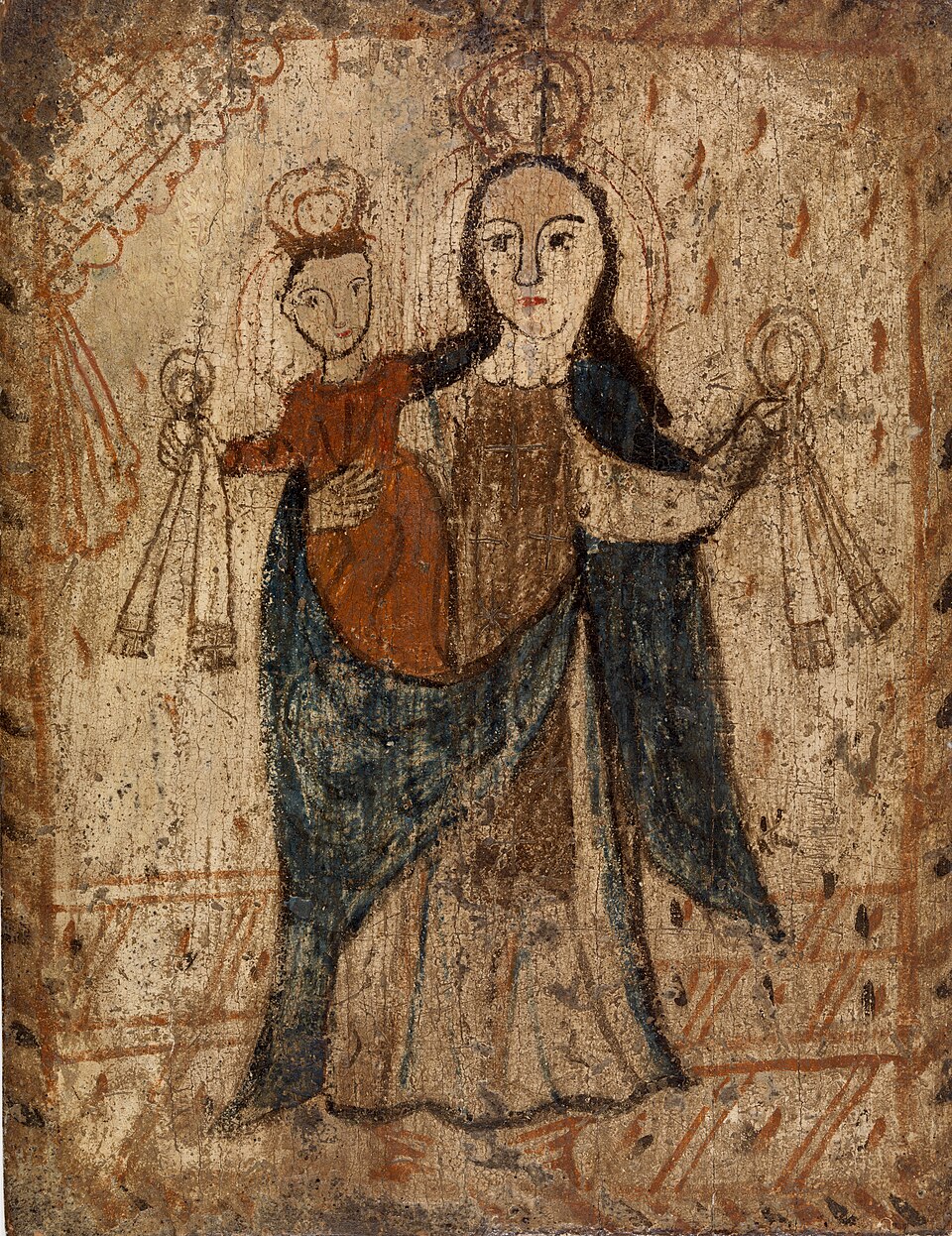
On May 5, 1933, the fallen-away priest Johann Kirchsteiger died in Aigen near Salzburg. He had worked much against the Church, as a writer and itinerant speaker, and interfered especially with Catholic teaching on marriage. Through his dispensations he drove many into concubinage and made many families unhappy.
One thing, however, he had kept: even as a fallen-away priest he wore the scapular, through which Mary obtained for him the grace of conversion.
When the 79-year-old came to die, he returned repentant to the Church and was reconciled with God at the last moment. After receiving the last sacraments, he passed away.22
22 Tragt das Skapulier!
Ah, with what love and tenderness God embraces a sinner when he returns to Him. St. John Bosco
The scapular is also a reminder of our baptismal garment. This represents the festal robe that the merciful Father offers to His children who have come home. Philippe de Jésus-Marie OCD
The Musket Ball in the Chest
In the year 1648, during the siege of the city of Ypres by the French, the captain of the regiment of Lombay received a musket ball in the chest. Fortunately the ball was flattened against his scapular, and he was not in the least injured. The flat ball was found in his clothes. To the admiration of all those present, the flattened ball bore the imprint of the image of the Most Blessed Virgin and the Child Jesus.23
23 Tragt das Skapulier!
Wear on your chest the holy scapular of Mount Carmel. St. Josemaría Escrivá
Mary’s Garment Protects from Misfortune
On May 8, 1842, a densely packed railway carriage caught fire in France while traveling at high speed. It took a long time before the people at the front, on the locomotive, became aware of the terrible accident and stopped the train. The screaming of the occupants had gone unheard.
When the train had been brought to a halt, the injured passengers were taken out at once. All had suffered burns, greater or lesser, and had to be taken to the hospital. Only a single one had come through, to everyone’s astonishment, without any injury.
He was asked about the cause of this striking, indeed perhaps miraculous rescue. He answered: I can think of no other than this. With that he pointed to the scapular that he wore. Ever since I have worn this, he continued, I commend myself daily to her special protection. And indeed, he was the only one among all the passengers who was clothed with this garment of the Mother of God.24
24 Das Kleid vom Himmel.
Condemned to Death
In the year 1625 a miracle with the scapular of Mount Carmel took place in Italy that caused the greatest excitement throughout Italy and was decisive for the great popularity of the scapular:
In the year 1620 Battista Bosio was accused of having murdered two noblemen. He had carried out this infamous deed on the orders of his master. After a certain time in prison he repented of his deed and was converted. He invoked the Mother of God of Mount Carmel and prepared himself for receiving the scapular by fasting in prison every Wednesday and Saturday. For three years he held faithfully to his resolutions. He asked the Mother of God of Mount Carmel to deliver him from his wretched condition. Through one of his friends he had obtained an image of Our Lady of the Scapular.
When he was condemned to death, Battista Bosio insisted on receiving the scapular. At his request the Carmelite father in Cremona came and invested him with the scapular. The death sentence by hanging was set for Saturday, March 22, 1625. The executioner bound the repentant wrongdoer with two strong ropes to a very high scaffold. But the first rope broke in several places. After the executioner had pulled away the ladder, the second rope broke as well.
The repentant sinner fell from the height of the scaffold onto the hard stone floor. He felt no pain. The bystanders crowded around the man who was so evidently protected by the Mother of God. Moved, they recognized an intervention of heaven, and the man condemned to death was pardoned. Through this miracle the scapular became known and beloved throughout Italy.25
25 Tragt das Skapulier!
Look at the jasmine bush. It gives off its best fragrance when the sun goes down. The holy scapular is just like that. It never helps better than in the hour of death, when life, that is, goes down. Abraham a Sancta Clara
The Testimony of Petrus Molles
In the year 1636 a man named Petrus Molles from Spain led an ungodly life. For this reason he lost the favor and benefactions of his own parents and became completely destitute. Thereupon this prodigal son fell into such despair that he resolved within himself to end his own life.
As he was about to climb a ladder with a rope around his neck in order to let himself fall from it, he was held back by an invisible force. But because he persisted obstinately in his ungodly purpose, the evil enemy appeared to him. He advised him to put aside the little piece of cloth of the scapular, otherwise he could not help him to his end, at which the poor fellow was dismayed. He repented of all his sins from his heart and changed his way of life.26
26 Ibid.
The Scapular on the Deathbed
Don Francisco Zaldúa, former president of the Republic of Colombia, was an excellent jurist, but at the same time a bitter enemy of the Catholic Church. He always followed the banner of the Liberals. He was one of the chief agitators in the expulsion of the Jesuits and the persecution to which they were subjected.
His son enjoyed an excellent education in Rome and had a particularly great devotion to the Most Blessed Virgin, whom he constantly begged for the conversion of his father, especially after he had been ordained a priest. Don Zaldúa fell critically ill, and everything the pious priest did to obtain his father’s conversion was in vain. Then he turned to Mary, the Refuge of Sinners.
When his father’s condition worsened so much that death seemed unavoidable, he redoubled his prayers. He went to the deathbed of the unfortunate man and said to him: Father, all human remedies are in vain. Will you not try the effectiveness of a supernatural medicine? – What kind of medicine? – That you receive and wear the scapular.27
The ex-president accepted the offer, bowed his head to receive the scapular, and asked what the scapular obliged him to do. – That you make a good confession. At this the poor dying man trembled with fear, but after a short while he said: Good, call a priest! After he had made a repentant confession, he declared in a loud voice that he wished to die as a true son of the Catholic Church.28
27 Through the mouths of the possessed, hell has been compelled to reveal that no priests harm it more than those who spread devotion to Mary and the holy scapular. Thus a demon once cried out from a possessed person: O garment, how many souls have you torn from me and from hell! (Das Schutzkleid Mariä)
28 Ibid.
The evil enemy is like a hawk that is always stalking the innocent doves. He is like a wolf whose teeth are forever watering for lambs. He is like a scorpion that is always supplied with poison. He is also a dog that never sleeps. But never does he watch and strive more, and never does he roar more, than in the hour of our death. Abraham a Sancta Clara
Blessing and Investiture of the Brown Scapular
Formula brevior. The priest wears a surplice and a white stole over the cassock.
V. Osténde nobis, Dómine, misericórdiam tuam.
Show us, O Lord, Your mercy.
R. Et salutáre tuum da nobis.
And grant us Your salvation.
V. Dómine, exáudi oratiónem meam.
O Lord, hear my prayer.
R. Et clamor meus ad te véniat.
And let my cry come to You.
V. Dóminus vobíscum.
The Lord be with you.
R. Et cum spíritu tuo.
And with your spirit.
Orémus.
Dómine Iesu Christe, humáni géneris Salvátor, hunc hábitum, quem propter tuum tuǽque Genetrícis Vírginis Maríæ de Monte Carmélo amórem servi tui (ancíllæ tuæ) devóte sunt delatúri (-æ) déxtera tua sanctí † fica, et eádem Genetríce tua intercedénte, ab hoste malígno defénsi (-æ) in tua grátia usque ad mortem persevérent: Qui vivis et regnas in sǽcula sæculórum. R. Amen.
Let us pray.
O Lord Jesus Christ, Savior of mankind, by Your right hand sanctify this habit, which Your servants will devoutly wear for love of You and of Your Mother, the Blessed Virgin Mary of Mount Carmel, so that, by her intercession, they may be protected from the wickedness of the enemy and persevere in Your grace until death. You who live and reign forever and ever. R. Amen.
He sprinkles the scapulars with holy water and invests each individual with it, saying:
Accipe hunc hábitum benedíctum precans sanctíssimam Vírginem, ut eius méritis illum pérferas sine mácula, et te ab ómni adversitáte deféndat, atque ad vitam perdúcat ætérnam. R. Amen.
Receive this blessed habit and ask the most holy Virgin that, by her merits, you may wear it without stain, and that she may defend you from all adversity and bring you to everlasting life. R. Amen.
After all have received the scapular, he says:
Ego, ex potestáte mihi concéssa, recípio te (vos) ad participatiónem ómnium bonórum spirituálium, quæ, cooperánte misericórdia Iesu Christi, a Religiósis de Monte Carmélo peragúntur. In nómine Patris, et Fílii, † et Spíritus Sancti. R. Amen.
By the power granted to me, I admit you to a share in all the spiritual works performed, with the merciful help of Jesus Christ, by the Religious of Mount Carmel. In the name of the Father, and of the Son, and of the Holy Spirit. R. Amen.
Bene † dícat te (vos) Cónditor cæli et terræ, Deus omnípotens, qui te (vos) cooptáre dignátus est in Confraternitátem beátæ Maríæ Vírginis de Monte Carmélo: quam exorámus, ut in hora óbitus tui (vestri) cónterat caput serpéntis antíqui, atque palmam et corónam sempitérnæ hereditátis tandem consequáris (consequámini). Per Christum Dóminum nostrum. R. Amen.
May almighty God, Creator of heaven and earth, bless you, whom He has been pleased to receive into the Confraternity of the Blessed Virgin Mary of Mount Carmel. We beseech her that, in the hour of your death, she crush the head of the ancient serpent, so that you may finally obtain the palm and crown of the eternal inheritance. Through Christ our Lord. R. Amen.
He sprinkles the person with holy water.
Prayer to the Queen of Carmel
O most blessed and immaculate Virgin, ornament and splendor of Carmel, you who regard with an eye of special kindness those who wear your blessed habit, look down also benignly upon me and cover me with the mantle of your special protection. Strengthen my weakness with your power; enlighten the darkness of my mind with your wisdom; increase in me faith, hope and charity. Adorn my soul with such graces and virtues as will ever be pleasing to your divine Son and to you. Assist me in life, and console me in death with your most amiable presence, and present me to the most august Trinity as your devoted servant and child, that I may eternally bless and praise you in paradise. Amen.
Three Hail Marys and Glory Be to the Father.
(Indulgenced prayer of Pope Leo XIII)
Truly, a great grace of the scapular: to share in all the prayers, vigils, almsgiving, fasting, Holy Masses, pilgrimages, mortifications, works of penance, all the hardships that are endured, even to the shedding of blood and the loss of life among unbelievers for the spreading of the faith, in short all the good that is done throughout the whole world in so many Carmelite monasteries through the mediation of the Most Blessed Virgin. Father Grossi, author of the Roman confraternity booklet
The scapular, the Rosary and the Miraculous Medal: these are three things that the Immaculata herself offered for the salvation of mankind. St. Maximilian Maria Kolbe